Arq. Bras. Oftalmol. 2019;82 (2 )
:98-102
| DOI: 10.5935/0004-2749.20190023
Abstract
Objetivo: Avaliar os impactos clínico e cirúrgico dos fenômenos que podem ocorrer na exotropia intermitente.
Métodos: Os prontuários de casos de exotropia intermitente de 1991 a 2014 foram revisados retrospectivamente. Todos os pacientes foram submetidos a uma serie de medidas incluindo o protocolo com oclusão monocular com base na propedêutica proposta por Kushner.
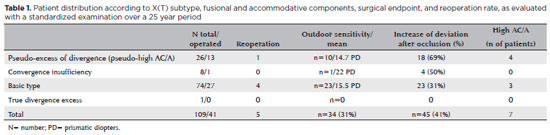
Resultados: Outdoor sensitivity foi observada em 31% dos pacientes com taxa de subcorreção de 44% vs. 18% dos casos sem outdoor sensitivity. Após 1 hora de oclusão monocular, 41% de todos os pacientes apresentaram um aumento no desvio com uma taxa de subcorreção 40%, enquanto 25% não.
Conclusão: Os resultados demonstram a importância da propedêutica completa, uma vez que há maior taxa de subcorreção tardia nos casos de outdoor sensitivity e maior desvio após a oclusão.
Keywords: Exotropia; Estrabismo; Músculos oculomotores; Privação sensorial; Visão monocular
Arq. Bras. Oftalmol. 2025;88 (2 )
:1-7
| DOI: 10.5935/0004-2749.2023-0317
Abstract
PURPOSE: This study aimed to evaluate the perception and degree of satisfaction of blind individuals regarding an electronic cane prototype with a wearable haptic interface.
METHODS: Two scenarios with different obstacles were created to conduct tests with the canes (the user's cane and the prototype one). The perception and satisfaction of participants regarding the electronic cane were assessed using a questionnaire, the number of collisions during the tests, and the time each individual took to complete the course in each scenario.
RESULTS: Ten blind individuals who used the white cane participated in this study. Eight were males, and two were females. Their age ranged from 23 to 43 (average 32.3 ± 7.13 years and median 32 years). There was a tendency for fewer collisions with ground obstacles when the electronic cane was used than when the white cane was used. However, there was no statistically significant difference between the number of collisions and the course completion time in each scenario with either canes tested.
CONCLUSION: Overall, the perception and satisfaction of individuals regarding the prototype used were positive.
Keywords: Blindness; Canes; Patient satisfaction; Perception; Haptic technology; Wearable electronic devices; Surveys and questionnaires


 ABO is licensed under a Creative Commons Attribution-NonComercial 4.0 Internacional.