Arq. Bras. Oftalmol. 2026;89 (6 )
:1-9
| DOI: 10.5935/0004-2749.2026-0078
Abstract
PURPOSE: To compare standard single-step transepithelial photorefractive keratectomy, planned using a population-derived epithelial thickness profile, with MS-39 epithelial thickness map-guided single-step transepithelial photorefractive keratectomy in eyes with regular corneas, with a focus on early epithelial healing and short-term visual and refractive outcomes.
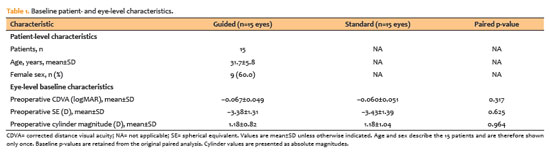
METHODS: This prospective, randomized, patient-masked, contralateral-eye clinical trial included 15 patients (30 eyes) with stable myopia, with or without regular astigmatism. Each patient underwent standard transepithelial photorefractive keratectomy in one eye and MS-39 epithelial map-guided transepithelial photorefractive keratectomy in the fellow eye using the same excimer laser platform and single-step transepithelial workflow. Early postoperative outcomes included pain scores and epithelial-defect area on postoperative day 2 and complete reepithelialization on day 7. Visual and refractive outcomes included uncorrected distance visual acuity at 30 and 90 days, corrected distance visual acuity at 90 days, residual spherical equivalent, and residual cylinder magnitude at 90 days. Paired analyses were performed.
RESULTS: All patients completed the 90-day follow-up. Early postoperative recovery did not differ significantly between groups. On day 2, the mean pain score was 2.33±0.82 in guided eyes and 2.40±0.63 in standard eyes, whereas the mean epithelial-defect area was 3.75±5.34 and 2.78±2.86 mm2, respectively. Complete reepithelialization by ay 7 occurred in all eyes. At 90 days, mean uncorrected distance visual acuity was −0.080±0.056 logMAR in guided eyes and −0.073±0.046 logMAR in standard eyes (p=0.564). Mean residual spherical equivalent was −0.03±0.35 D and 0.00±0.41 D, respectively (p=0.831). A total of 93.3% of guided eyes and 86.7% of standard eyes were within ±0.50 D of plano, and all eyes were within ±1.00 D.
CONCLUSIONS: In this randomized contralateral-eye pilot study, MS-39 epithelial map-guided single-step transepithelial photorefractive keratectomy did not demonstrate a statistically detectable short-term clinical advantage over standard population-based planning in eyes with regular corneas. Because the study was not designed as an equivalence or noninferiority trial, these findings should not be interpreted as evidence of equivalence.
Keywords: Photorefractive keratectomy/methods; Cornea/physiopathology; Corneal epithelium/surgery; Myopia/surgery; Astigmatism/surgery; Corneal topography; Refraction, ocular/physiology


 ABO is licensed under a Creative Commons Attribution-NonComercial 4.0 Internacional.