Arq. Bras. Oftalmol. 2026;89 (2 )
:1-8
| DOI: 10.5935/0004-2749.2025-0105
Abstract
PURPOSE: To evaluate structural differences in amniotic membrane fragments subjected to different preservation techniques for potential ophthalmologic applications.
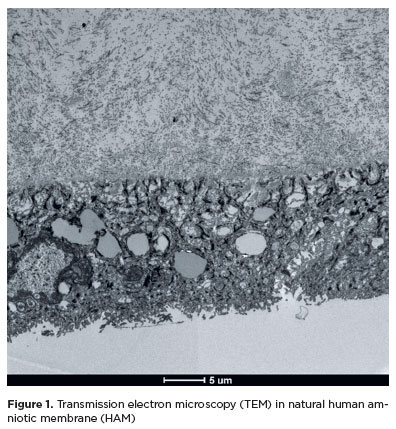
METHODS: Three placentas were collected from healthy donors, and four amniotic membrane fragments were prepared from each placenta. The fragments were divided into four groups with three samples each: cryopreserved, lyophilized, vacuum-dried using a vacuum concentrator, and fresh (control). After processing, the fragments were fixed, sectioned, and analyzed using scanning transmission electron microscopy to assess tissue morphology.
RESULTS: All samples met the established evaluation criteria. No morphological differences were observed among the groups. The structural characteristics of lyophilized and vacuum-dried membranes were comparable with those of cryopreserved and fresh membranes. However, vacuum drying demonstrated the greatest practicality for ophthalmologic use, as it allows membrane availability at any time and storage at room temperature.
CONCLUSION: Vacuum drying using a vacuum concentrator, lyophilization, and cryopreservation preserve the morphological characteristics of the human amniotic membrane similar to those of fresh tissue. A standardized protocol using a vacuum concentrator may be established owing to its advantages in storage convenience and accessibility.
Keywords: Amnion/transplantation; Cryopreservation/methods; Freeze drying; Lyophilization; Ophthalmologic surgical procedures; Regenerative medicine
Arq. Bras. Oftalmol. 2025;88 (2 )
:1-7
| DOI: 10.5935/0004-2749.2023-0317
Abstract
PURPOSE: This study aimed to evaluate the perception and degree of satisfaction of blind individuals regarding an electronic cane prototype with a wearable haptic interface.
METHODS: Two scenarios with different obstacles were created to conduct tests with the canes (the user's cane and the prototype one). The perception and satisfaction of participants regarding the electronic cane were assessed using a questionnaire, the number of collisions during the tests, and the time each individual took to complete the course in each scenario.
RESULTS: Ten blind individuals who used the white cane participated in this study. Eight were males, and two were females. Their age ranged from 23 to 43 (average 32.3 ± 7.13 years and median 32 years). There was a tendency for fewer collisions with ground obstacles when the electronic cane was used than when the white cane was used. However, there was no statistically significant difference between the number of collisions and the course completion time in each scenario with either canes tested.
CONCLUSION: Overall, the perception and satisfaction of individuals regarding the prototype used were positive.
Keywords: Blindness; Canes; Patient satisfaction; Perception; Haptic technology; Wearable electronic devices; Surveys and questionnaires


 ABO is licensed under a Creative Commons Attribution-NonComercial 4.0 Internacional.