Arq. Bras. Oftalmol. 2026;89 (2 )
:1-5
| DOI: 10.5935/0004-2749.2025-0181
Abstract
PURPOSE: To assess the one-year impact of prostaglandin analog (travoprost) on periorbital appearance and lower eyelid horizontal tension, compared with the contralateral eye treated with Pascal selective laser trabeculoplasty.
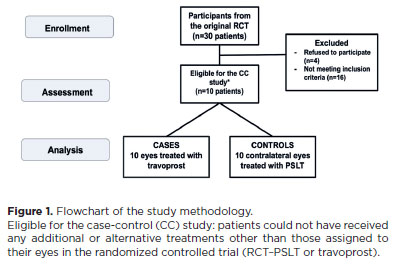
METHODS: This nested case-control study was derived from a non-inferiority randomized clinical trial comparing Pascal selective laser trabeculoplasty efficacy with travoprost in fellow eyes over 12 months. One eye received daily travoprost, while the contralateral eye underwent Pascal selective laser trabeculoplasty. Lower eyelid horizontal tension was measured using a validated digital imaging method, and prostaglandin-associated periorbitopathy signs were graded by masked observers. Statistical analyses included generalized estimating equations and the Mann–Whitney U test for nonparametric data, with p<0.05 considered significant.
RESULTS: Ten patients met the inclusion criteria for this subanalysis. Travoprost-treated eyes had significantly lower mean lower eyelid distension compared with Pascal selective laser trabeculoplasty-treated eyes (4.32 mm vs. 5.02 mm; mean difference: 0.70 mm; p<0.001). Prostaglandin-associated periorbitopathy scores were significantly higher in the travoprost group, reflecting more pronounced changes in ptosis, periorbital hyperpigmentation, and eyelid retraction.
CONCLUSIONS: Chronic use of prostaglandin analogs is associated with notable periorbital changes and increased lower eyelid tension, potentially affecting aesthetics and ocular function. Pascal selective laser trabeculoplasty may offer a safer profile for preserving periorbital anatomy while maintaining effective intraocular pressure control. Laser trabeculoplasty should be considered as an initial treatment when appropriate to minimize cosmetic and functional changes from chronic topical therapy.
Keywords: Prostaglandin analogs; Selective laser trabeculoplasty; Periorbitopathy; Eyelid tension; Glaucoma treatment
Arq. Bras. Oftalmol. 2025;88 (4 )
:1-8
| DOI: 10.5935/0004-2749.2024-0277
Abstract
PURPOSE: This retrospective study evaluated the safety and efficacy of real-world antiangiogenic therapy for ocular conditions in the private healthcare sector in southern Brazil.
METHODS: Medical records from patients who underwent intravitreal anti-vascular endothelial growth factor injections over the past 12 years were reviewed retrospectively. Data collection included the primary diagnoses, drugs administered, injection techniques, adverse effects, and treatment efficacy. Efficacy was assessed by comparing pre- and posttreatment visual acuity and central subfield thickness in eyes with followup exceeding 2 years.
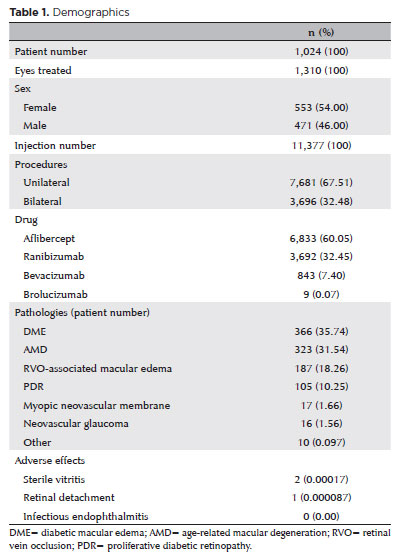
RESULTS: A total of 1,024 patients, 1,310 treated eyes, and 11,377 injections were analyzed. The injections included aflibercept (6,833), ranibizumab (3,692), bevacizumab (843), and brolucizumab (9), administered either bilaterally (3,696) or unilaterally (7,681). The most common diagnoses were diabetic macular edema, exudative age-related macular degeneration, retinal vein occlusion related macular edema, and proliferative diabetic retinopathy. No endophthalmitis cases were reported. Vitritis with transient visual acuity loss occurred in two cases following aflibercept injections. One retinal detachment case was successfully treated with vitrectomy. The median number of injections per patient was 6 (IQR [interquartile range], 3–13). Among 445 eyes from 328 patients with followup over 2 years (median, 4.05 years; IQR, 2.89–6.29), there was a significant improvement in best-corrected visual acuity from 0.3 to 0.4 (Snellen) (p<0.001) and a reduction in central subfield thickness from 361 to 267 microns (p<0.001). CST comparisons included patients with age-related macular degeneration, diabetic macular edema, and retinal vein occlusion related macular edema.
CONCLUSION: This real-world study, the largest of its kind in Brazil, confirms the safety and efficacy of antiangiogenic therapies in the southern Brazilian private healthcare system. The findings highlight a low incidence of severe adverse events and outcomes consistent with global studies, supporting the ongoing use of antiangiogenic agents as effective and well-tolerated treatments for various ocular conditions in developing countries.
Keywords: Antiangiogenic drugs; Macular edema; Age-related macular degeneration; Retinal vein occlusion; Patient safety


 ABO is licensed under a Creative Commons Attribution-NonComercial 4.0 Internacional.