Arq. Bras. Oftalmol. 2025;88 (3 )
:1-8
| DOI: 10.5935/0004-2749.2024-0104
Abstract
PURPOSE: This study aimed to characterize retinitis pigmentosa associated with the eyes shut homolog gene, which causes hereditary retinal degeneration.
METHODS: The anatomical and functional findings of retinitis pigmentosa in patients with variants of the eyes shut homolog gene were characterized and compared using multimodal imaging and genetic analysis of the variants. Clinical data such as visual acuity, lens status, and refraction were obtained from medical records. Patients underwent an ophthalmic examination, including static visual field, microperimetry, optical coherence tomography, fundus autofluorescence, and fundus photography.
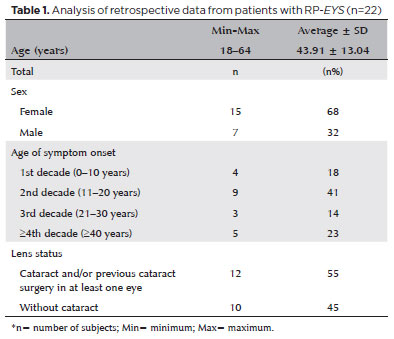
RESULTS: Twenty-two patients were included in the study. Several anatomical and functional characteristics of retinitis pigmentosa-eyes shut homolog were identified, including the presence of cataracts, cystoid macular edema, epiretinal membrane, and a tubular visual field. Genetic results revealed 26 distinct variants in the cohort, with 7 novel variants not previously documented or reported in the scientific literature or databases.
CONCLUSION: The findings demonstrate that eyes shut homolog-retinitis pigmentosa manifests in specific patterns, starting in adolescence with mild progression and advancing with age. The integration of multimodal imaging and genetic analysis has provided a detailed understanding of the anatomical and functional features of retinitis pigmentosa-eyes shut homolog. Seven novel variants of the eyes shut homolog gene have been identified. These findings enhance the understanding of eyes shut homolog-related retinitis pigmentosa characteristics of by detailing the spectrum of mutations in this gene within the Brazilian population.
Keywords: Retinal diseases/diagnostic imaging; Retinitis pigmentosa/genetics; Retinal degeneration; Eye proteins/genetics; Eye diseases, hereditary/genetics; Genes, recessive; Phenotype; Multimodal imaging; Tomography, optical coherence/methods; Fluorescein angiogr
Arq. Bras. Oftalmol. 2024;87 (4 )
:1-12
| DOI: 10.5935/0004-2749.2023-0042
Abstract
PURPOSE: To assess the quality of life in patients diagnosed as having tuberculous uveitis and its association with sociodemographic, clinical, and psychosocial aspects.
METHOD: By conducting standardized interviews, clinical and demographic data were collected using a measure developed in this study. This measure was applied in addition to other measures, namely SF-12, Hospital Anxiety and Depression Scale, and NEI-VFQ-39, which were used to assess health-related quality of life, anxiety and depression symptoms, and visual functioning.
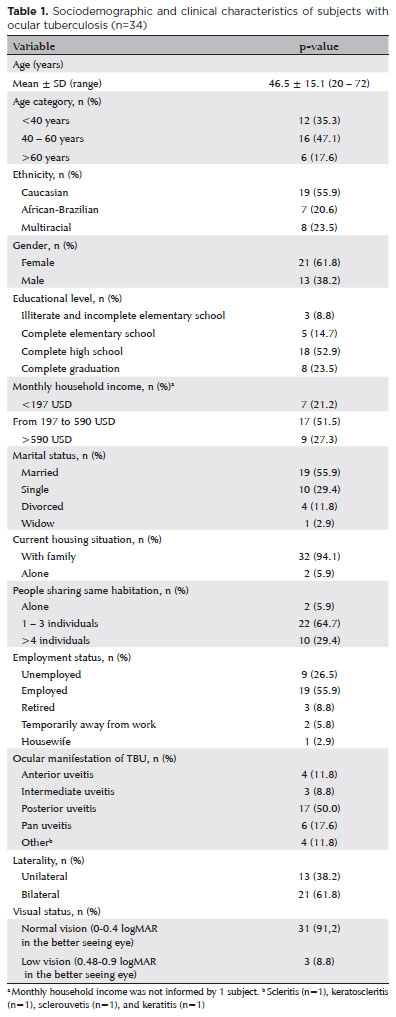
RESULTS: The study included 34 patients [mean age: 46.5 ± 15.1 years, female patients: 21 (61.8%)]. The mean of the VFQ-39 score was 74.5 ± 16.6 and that of SF-12 physical and mental component scores were 45.8 ± 10.1 and 51.6 ± 7.5, respectively, for the health-related quality of life. Anxiety symptoms were the most prevalent compared with depression symptoms and were found in 35.3% of the participants.
CONCLUSION: Tuberculous uveitis affects several scales of quality of life, thereby affecting a population economically active with a social, psychological, and economic burden.
Keywords: Tuberculosis, ocular; Quality of life; Uveitis; Anxiety; Depression; Surveys and questionnaires


 ABO is licensed under a Creative Commons Attribution-NonComercial 4.0 Internacional.