Arq. Bras. Oftalmol. 2024;87 (1 )
:1-7
| DOI: 10.5935/0004-2749.2021-0048
Abstract
Objetivo: Identificar parâmetros tomográficos de normalidade em córneas de crianças e adolescentes sem a presença de atopias sistêmicas e alergias oculares.
Métodos: Este estudo descritivo transversal avaliou pacientes com idade entre 8 e 16 anos que foram submetidos a exame biomicroscópico completo por lâmpada de fenda e avaliação tomográfica da córnea por tomógrafo dual Scheimpflug, excluindo pacientes com doença ocular (incluindo conjuntivite alérgica) ou prick test positivo para atopias sistêmicas.
Resultados: Cento e setenta pacientes foram avaliados e após cumpridos os critérios de exclusão, 34 (68 olhos) foram analisados. A média etária da amostra foi 10,76 ± 2,31 anos; 19 (55,9%) eram meninos e 15 (44,1%) meninas. A média da ceratometria em dioptrias (D) no meridiano mais plano (Kflat), mais curvo (Ksteep) e máxima (Kmax) foram 42,37 ± 1,63D, 43,53 ± 1,65D e 43,90 ± 1,73D, respectivamente. Os valores médios da asfericidade corneana (ε2) e do ponto mais fino da córnea foram 0,28 ± 0,11 e 550,20 ± 37,90 micras (μm). A assimetria corneana inferior-superior (I-S) e coma foi em média 0,74 ± 0,59D e 0,28 ± 0,12D, respectivamente.
Conclusão: O conhecimento dos valores médios e sua variação de parâmetros tomográficos da córnea em crianças e adolescentes sem atopias sistêmicas ou alergias oculares pode ser útil para o diagnóstico precoce do ceratocone e o seu tratamento em estágio inicial.
Keywords: Córnea; Topografia corneana; Astigmatismo; Conjuntivite alérgica; Tomografia; Ceratocone/diagnóstico; Humanos; Criança; Adolescente.
Arq. Bras. Oftalmol. 2026;89 (1 )
:1-8
| DOI: 10.5935/0004-2749.2024-0212
Abstract
PURPOSE: To analyze the association between corneal tomography patterns and atopic conditions in children and adolescents, and to investigate the relationship between corneal tomography findings, sleeping position, and dominant hand.
METHODS: Patients aged 8–16 yr underwent ocular and immunological examinations, including biomicroscopy, corneal tomography, the International Study of Asthma and Allergies in Childhood questionnaire, and an allergy skin test. Based on immunological results, participants were assigned to either the Control Group or the Atopic Group. Tomographic indices were analyzed alongside information on ocular itching, sleeping position, and dominant hand.
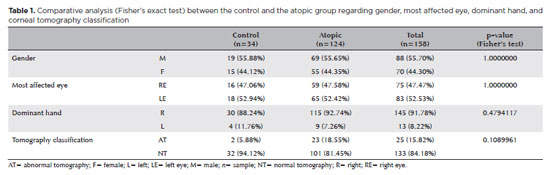
RESULTS: A total of 158 patients (mean age: 10.72 ± 2.13 yr) were evaluated, including 34 (21.52%) in the Control Group and 124 (78.48%) in the Atopic Group. Abnormal tomography was observed in 25 patients (15.82%), while 133 (84.18%) had normal results. Comparison between the Control and Atopic Groups regarding ocular itching episodes revealed a statistically significant difference (p≤0.05). Dominant hand and sleeping position showed no statistically significant associations with group classification, tomography results, or ocular itching.
CONCLUSION: Systemic allergies are strongly associated with biomechanical and structural corneal changes, which may or may not progress to different keratoconus patterns. No association was found between eye rubbing and any tomographic parameter, nor between sleeping position or hand dominance and tomography findings.
Keywords: Adolescent; Child; Hypersensitivity; Hypersensitivity, immediate; Cornea; Skin tests; Sleep; Tomography.
Arq. Bras. Oftalmol. 2024;87 (4 )
:1-8
| DOI: 10.5935/0004-2749.2023-0054
Abstract
PURPOSE: The prevalence of ocular allergy varies according to the population and location of the study. Severe forms of ocular allergy are associated with compromised quality of life. In this study, we aimed to evaluate the application of the Brazilian-Portuguese version of the Quality of Life in Children with Keratoconjunctivitis questionnaire to children and adolescents with different subtypes of allergic conjunctivitis.
METHOD: A total of 48 patients (aged 5-12 years) with allergic conjunctivitis were included in this study. They were enrolled and monitored at a specialized center. After the clinical appointment, the children responded to the questionnaire on two occasions at an interval of 30 days. Individual scores (ranging from 0 to 3) of the 16 items were added.
RESULTS: The Brazilian-Portuguese version of the Quality of Life in Children with Keratoconjunctivitis questionnaire demonstrated good translation, adaptation, and intellectual properties, with substantial internal consistency (Cronbach's α coefficient = 0.702). There was no significant difference between the responses of the two interviews, revealing good reproducibility. The moderate/severe forms of allergic conjunctivitis had significantly higher quality of life scores (indicating a poorer quality of life) than the mild forms.
CONCLUSIONS: The Brazilian-Portuguese version of the Quality of Life in Children with Keratoconjunctivitis proved to be quick, reliable, and reproducible for assessing the quality of life in children with allergic conjunctivitis. However, its ability to detect changes resulting from symptom aggravation or treatment needs to be further evaluated.
Keywords: Conjunctivitis, allergic; Keratoconjunctivitis; Hypersensitivity; Quality of life; Child; Surveys and questionnaires


 ABO is licensed under a Creative Commons Attribution-NonComercial 4.0 Internacional.


06-fig01.jpg)