Arq. Bras. Oftalmol. 2014;77 (3 )
:168-172
| DOI: 10.5935/0004-2749.20140043
Abstract
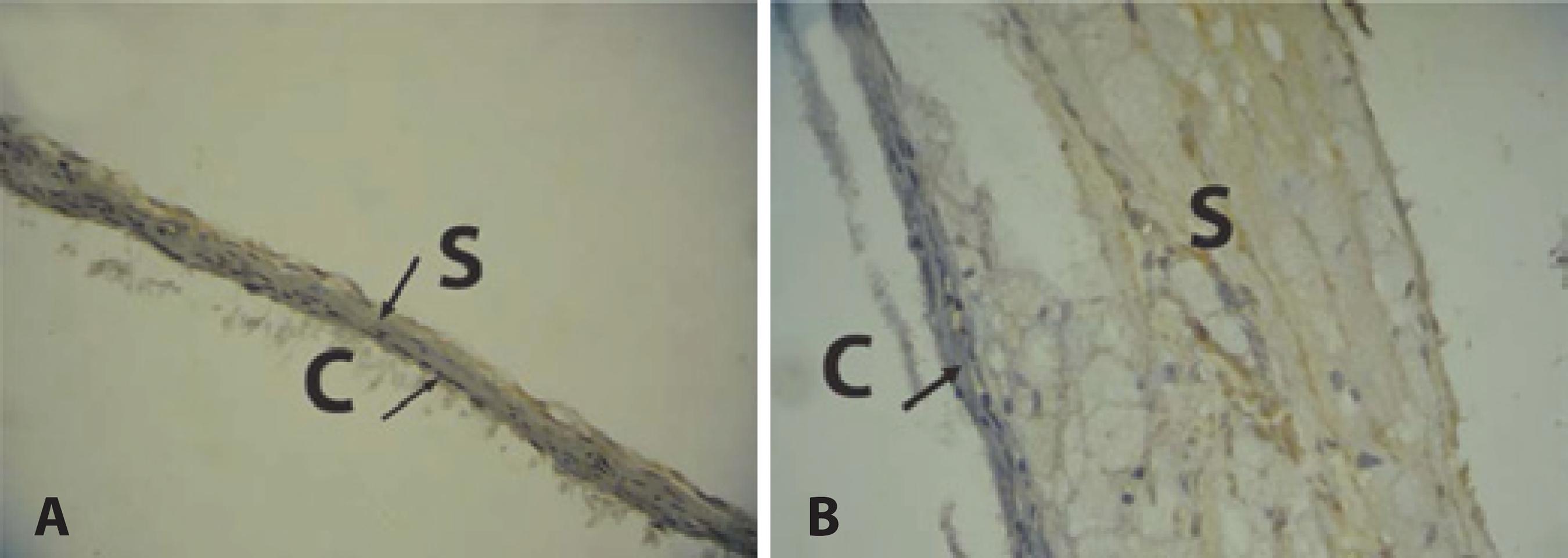
Objetivo: Avaliar a expressão das citocinas inflamatórias TNF-α e IL-6 na esclera e coroide de coelhos hipercolesterolêmicos. Método: Coelhos New Zealand foram organizados em dois grupos: GN recebeu ração padrão para coelhos; GH recebeu dieta rica em colesterol a 1%. Foi realizada a dosagem sérica de colesterol total, triglicerídeos, HDL colesterol, glicemia de jejum no início do experimento e no momento da eutanásia. Ao final da 4ª semana para o GN e 8ª semana para o GH foi realizada a eutanásia dos animais. Os olhos foram submetidos à análise imuno-histoquímica com os anticorpos TNF-α e IL-6. Resultados: O GH manifestou significativo aumento do colesterol total e triglicerídeos em relação ao GN (p<0,001). Houve significativo aumento da expressão da TNF-α (p<0,001) e da IL-6 (p=0,002) na coroide e esclera dos animais do GH em relação ao GN. Conclusão: Este estudo demonstra que a dieta hipercolesterolêmica induz ao aumento da expressão das citocinas TNF-α e IL-6 na coroide e esclera de coelhos.
Keywords: Colesterol; Macrófagos; Citocinas; Fator de necrose tumoral; Interleucina-6; Coroide; Esclera; Degeneração macular
Arq. Bras. Oftalmol. 2026;89 (6 )
:1-7
| DOI: 10.5935/0004-2749.2026-0183
Abstract
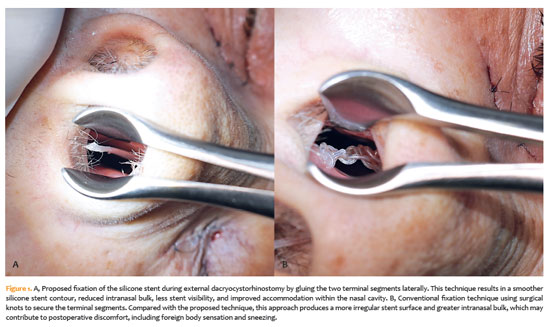
PURPOSE: To compare surgical outcomes and patient tolerability between conventional knotted fixation and a novel technique using cyanoacrylate gel glue to secure the silicone stent during external dacryocystorhinostomy.
METHODS: This retrospective study included 70 patients who underwent external dacryocystorhinostomy, of whom 40 received cyanoacrylate glue fixation (study group) and 30 underwent conventional knotted fixation (control group). Patients with congenital or acquired lacrimal obstruction and a minimum follow-up period of 6 months were included. All procedures were performed by the same surgeon at a single institution. Patient tolerability, including foreign body sensation, sneezing, and nasal secretion, and surgical complications, including glue-induced toxicity, infection, stent extrusion, mobilization, release, and pyogenic granuloma, were assessed. Data were analyzed using descriptive statistics and nonparametric tests.
RESULTS: The median patient age was 69.0 years (range, 3–90 years), and most patients were women (81.4%, n=57). There were no significant differences between the groups in age (p=0.264) or sex (p=0.213). Symptoms were reported by 34.3% of patients and were significantly more frequent in the control group than in the study group (33.3% vs. 10.0%, p<0.001). Foreign body sensation (p=0.002), sneezing (p=0.012), and nasal secretion (p<0.001) were all significantly more common in the control group. Overall, complications were infrequent, with no significant between-group differences in stent release (17.5% vs. 20.0%, p=0.790), mobilization (5.0% vs. 16.7%, p=0.130), or infection (2.9% vs. 0%, p=0.503). No cases of glue-induced toxicity were observed. Follow-up duration did not differ significantly between the groups.
CONCLUSIONS: Cyanoacrylate fixation was associated with favorable patient tolerability and no increase in complication rates compared with conventional knotted fixation. These findings suggest that cyanoacrylate glue may be a safe and well-tolerated alternative for silicone stent fixation during external dacryocystorhinostomy.
Keywords: Dacryocystorhinostomy/methods; Lacrimal duct obstruction; Nasolacrimal duct/surgery; Intubation; Cyanoacrylates; Adhesives; Stent; Silicones; Comparative study


 ABO is licensed under a Creative Commons Attribution-NonComercial 4.0 Internacional.