Arq. Bras. Oftalmol. 2026;89 (6 )
:1-9
| DOI: 10.5935/0004-2749.2025-0294
Abstract
PURPOSE: To compare obstructive sleep apnea screening classifications, anthropometric characteristics, and mechanical behaviors between participants with keratoconus and controls and to explore their associations with disease severity.
METHODS: This prospective cross-sectional study included 74 participants with keratoconus and 49 controls. The paper-based Berlin and STOP-BANG questionnaires were administered face-to-face by a researcher and scored manually. A study-specific questionnaire assessed eye rubbing and sleep position, whereas a separate structured field recorded self-reported ocular compression during sleep. Both groups underwent corneal tomography. The primary logistic regression model included age, sex, body mass index (BMI), eye rubbing, and ocular compression.
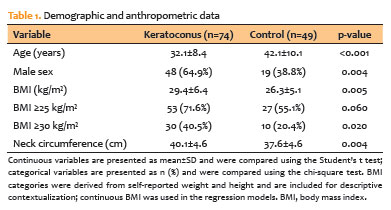
RESULTS: Participants with keratoconus had a higher BMI (29.4±6.4 vs. 26.3±5.1 kg/m²; p=0.005), larger neck circumference (40.1±4.6 vs. 37.6±4.6 cm; p=0.004), more frequent eye rubbing (71.6% vs. 51.0%; p=0.020), and more frequent ocular compression (43.2% vs. 20.4%; p=0.009) than controls. High-risk classifications did not differ significantly between groups according to either the Berlin Questionnaire (p=0.206) or STOP-BANG (p=0.139). In exploratory models adjusted for age and sex, positive associations were observed for the Berlin Questionnaire (OR, 2.58; 95% CI, 0.91-7.28) and STOP-BANG (OR, 3.30; 95% CI, 0.83-13.05). In the primary model, younger age (OR, 0.88; 95% CI, 0.83-0.93), male sex (OR, 2.91; 95% CI, 1.14-7.42), and higher BMI (OR, 1.15; 95% CI, 1.05-1.27) remained associated with keratoconus, whereas the estimates for behavioral factors were attenuated. No association with disease severity was detected.
CONCLUSIONS: Participants with keratoconus had higher anthropometric measurements and more frequent mechanical behaviors; however, the prevalence of high-risk obstructive sleep apnea classifications did not differ significantly between groups. Questionnaire-based and anthropometric findings are not independent because BMI contributes to both screening instruments, whereas neck circumference contributes to the STOP-BANG score. Ocular compression was assessed using a nonvalidated self-report measure rather than objective pressure measurements. Severity analyses were underpowered, and causality cannot be inferred from the study design.
Keywords: Keratoconus; Sleep apnea, obstructive; Risk factors; Body mass index; Sleep; Logistic models; Patient acuity; Tomography; Surveys and questionnaires


 ABO is licensed under a Creative Commons Attribution-NonComercial 4.0 Internacional.