Arq. Bras. Oftalmol. 2024;87 (3 )
:1-7
| DOI: 10.5935/0004-2749.2022-0374
Abstract
PURPOSE: To describe a 2019 acute toxoplasmosis outbreak in the city of São Paulo, Brazil, and to evaluate the laboratory serological profile for toxoplasmosis for three consecutive years. The ophthalmological manifestations of the patients involved in the outbreak were also studied.
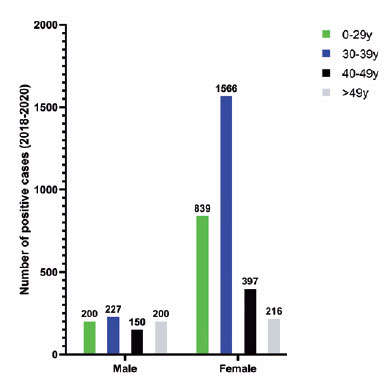
METHODS: A cross-sectional descriptive study of a toxoplasmosis outbreak in São Paulo, Brazil, between February and May 2019. Epidemiological data were described, as were the observed ocular manifestations. As part of this study the number of patients with positive IgM toxoplasmosis serology was obtained from a large laboratory network (DASA) for three consecutive years, including the year of the outbreak (2018, 2019, 2020).
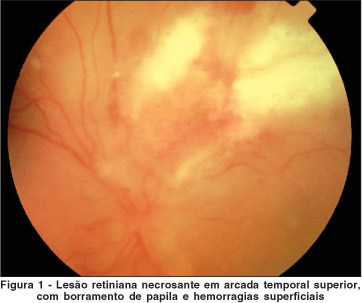
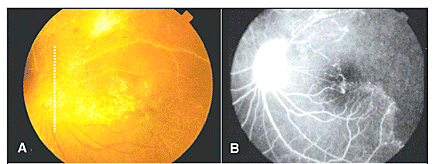
RESULTS: Eighty-three individuals were identified in the outbreak and two clusters were studied. The clinical picture of at least 77% of the patients, the epidemiological analysis, and the short incubation period (5-8 days) suggested contamination by oocysts. Serological laboratory data analysis revealed an increase of positive toxoplasmosis IgM in 2019 of 73% compared to the previous year. Ophthalmological examination revealed that at least 4.8% of the patients developed toxoplasmic retinochoroiditis, none of whom had been treated during the acute systemic disease.
CONCLUSION: Our findings indicate vegetable contamination as the possible source of this outbreak, a high prevalence of toxoplasmosis in São Paulo during the outbreak period, and a drop in the number of tests during the COVID-19 pandemic. Retinochoroiditis was observed in at least 4.8% of the cases. We confirm the need to implement effective means for the prevention, diagnosis, and treatment of the disease. This may involve raising awareness among the population of the importance of vegetable hygiene, and improved quality control of food and water.
Keywords: Toxoplasmosis/etiology; Food parasitology; Water/parasitology; Uveitis, posterior/parasitology; Chorioretinitis/parasitology; Visual acuity; Disease outbreaks; Eye manifestations; Humans.
Arq. Bras. Oftalmol. 2024;87 (4 )
:1-12
| DOI: 10.5935/0004-2749.2023-0042
Abstract
PURPOSE: To assess the quality of life in patients diagnosed as having tuberculous uveitis and its association with sociodemographic, clinical, and psychosocial aspects.
METHOD: By conducting standardized interviews, clinical and demographic data were collected using a measure developed in this study. This measure was applied in addition to other measures, namely SF-12, Hospital Anxiety and Depression Scale, and NEI-VFQ-39, which were used to assess health-related quality of life, anxiety and depression symptoms, and visual functioning.
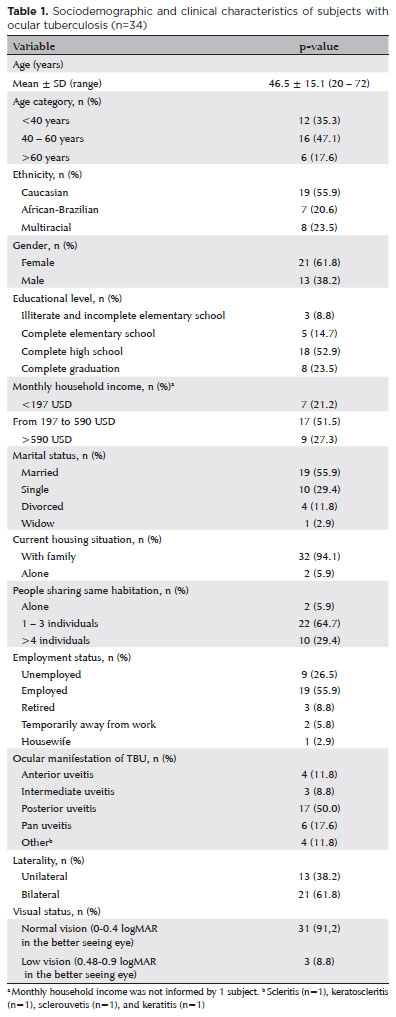
RESULTS: The study included 34 patients [mean age: 46.5 ± 15.1 years, female patients: 21 (61.8%)]. The mean of the VFQ-39 score was 74.5 ± 16.6 and that of SF-12 physical and mental component scores were 45.8 ± 10.1 and 51.6 ± 7.5, respectively, for the health-related quality of life. Anxiety symptoms were the most prevalent compared with depression symptoms and were found in 35.3% of the participants.
CONCLUSION: Tuberculous uveitis affects several scales of quality of life, thereby affecting a population economically active with a social, psychological, and economic burden.
Keywords: Tuberculosis, ocular; Quality of life; Uveitis; Anxiety; Depression; Surveys and questionnaires


 ABO is licensed under a Creative Commons Attribution-NonComercial 4.0 Internacional.