Arq. Bras. Oftalmol. 2023;86 (5 )
:1-6
| DOI: 10.5935/0004-2749.20230064
Abstract
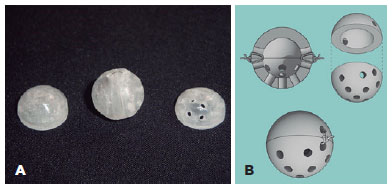
Objetivo: Avaliar a resposta tecidual e clínica a um implante orbitário de polimetilmetacrilato, oco e multiperfurado em sua porção posterior em modelo animal após evisceração.
Métodos: Dezesseis coelhos da raça Nova Zelândia foram submetidos à evisceração do globo ocular direito. Todos receberam implante oco de polimetilmetacrilato de 12 mm de diâmetro, multiperfurado em sua semiesfera posterior. O estudo foi dividido em avaliação clínica e histopatológica. A avaliação clínica foi diária até 14 dias pós-evisceração e, a cada sete dias, até completar 180 dias. Os animais foram divididos em grupos de quatro animais e cada um foi submetido à exenteração com 07, 30, 90 e 180 dias e depois à eutanásia. A análise histopatológica teve por fim caracterizar o padrão inflamatório, a estrutura do colágeno e o grau de neovascularização. Para isso, além da tradicional coloração pela hematoxilina-eosina, utilizou-se o corante Picrosirius Red (PSR) e imuno-histoquímica com o marcador CD 34.
Resultados: Não houve sinais de infecção, afinamento conjuntival ou escleral, exposição ou extrusão do implante em nenhum animal durante o estudo. Já no sétimo dia, o tecido neoformado migrou para dentro do implante formando uma rede fibrovascular através dos canais posteriores. A resposta inflamatória diminuiu ao longo do tempo avaliado e não foram encontradas células gigantes multinucleadas.
Conclusão: O implante analisado permite a sua integração aos tecidos orbitários pelo crescimento fibrovascular em seu interior. Os autores acreditam que este modelo de implante orbital pode fazer parte de testes com humanos.
Keywords: Implantes orbitários; Polimetilmetacrilato; Evisceração ocular; Anoftalmia; Procedimentos cirúrgicos oftalmológicos; Coelhos.
Arq. Bras. Oftalmol. 2026;89 (6 )
:1-7
| DOI: 10.5935/0004-2749.2026-0183
Abstract
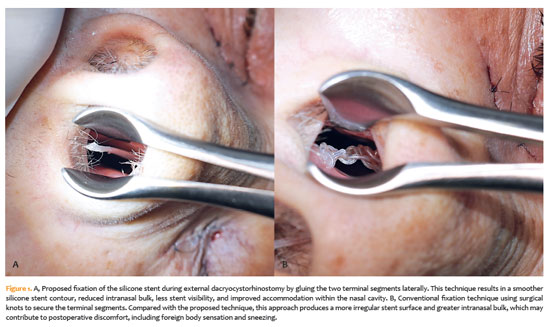
PURPOSE: To compare surgical outcomes and patient tolerability between conventional knotted fixation and a novel technique using cyanoacrylate gel glue to secure the silicone stent during external dacryocystorhinostomy.
METHODS: This retrospective study included 70 patients who underwent external dacryocystorhinostomy, of whom 40 received cyanoacrylate glue fixation (study group) and 30 underwent conventional knotted fixation (control group). Patients with congenital or acquired lacrimal obstruction and a minimum follow-up period of 6 months were included. All procedures were performed by the same surgeon at a single institution. Patient tolerability, including foreign body sensation, sneezing, and nasal secretion, and surgical complications, including glue-induced toxicity, infection, stent extrusion, mobilization, release, and pyogenic granuloma, were assessed. Data were analyzed using descriptive statistics and nonparametric tests.
RESULTS: The median patient age was 69.0 years (range, 3–90 years), and most patients were women (81.4%, n=57). There were no significant differences between the groups in age (p=0.264) or sex (p=0.213). Symptoms were reported by 34.3% of patients and were significantly more frequent in the control group than in the study group (33.3% vs. 10.0%, p<0.001). Foreign body sensation (p=0.002), sneezing (p=0.012), and nasal secretion (p<0.001) were all significantly more common in the control group. Overall, complications were infrequent, with no significant between-group differences in stent release (17.5% vs. 20.0%, p=0.790), mobilization (5.0% vs. 16.7%, p=0.130), or infection (2.9% vs. 0%, p=0.503). No cases of glue-induced toxicity were observed. Follow-up duration did not differ significantly between the groups.
CONCLUSIONS: Cyanoacrylate fixation was associated with favorable patient tolerability and no increase in complication rates compared with conventional knotted fixation. These findings suggest that cyanoacrylate glue may be a safe and well-tolerated alternative for silicone stent fixation during external dacryocystorhinostomy.
Keywords: Dacryocystorhinostomy/methods; Lacrimal duct obstruction; Nasolacrimal duct/surgery; Intubation; Cyanoacrylates; Adhesives; Stent; Silicones; Comparative study


 ABO is licensed under a Creative Commons Attribution-NonComercial 4.0 Internacional.