Arq. Bras. Oftalmol. 2022;85 (6 )
:614-619
| DOI: 10.5935/0004-2749.20220083
Abstract
Objetivo: Avaliar a frequência dos sintomas oftalmológicos, neurológicos e sistêmicos mais comuns em pacientes sintomáticos atendidos no serviço de triagem de COVID-19 do Hospital das Clínicas da UFPE.
Métodos: Cento e quatro pacientes com suspeita clínica de infecção por Sars-Cov-2 foram submetidos a avaliação médica e aplicação de questionário sobre a sintomatologia oftalmológica, neurológica e sistêmica. Todos os participantes do estudo tiveram exame de RT-PCR para COVID-19 solicitado.
Resultados: A média de idade foi de 38,8 anos, com 44,23% entre 31 e 40 anos. Mulheres corresponderam a 68,27% dos atendimentos e homens a 31,73%. Os sintomas mais frequentes nos pacientes com RT-PCR positivo foram: tosse (69,23%), febre (42,3%), mialgia (38,46%), hiposmia (38,46%), e ageusia (30,77%). Neste grupo, os sintomas oftalmológicos estiveram presentes em 34,61%, sendo: ardor (19,23%), dor ocular (11,54%), sensação de corpo estranho (7,7%), hiperemia (7,7%) e lacrimejamento (3,84%) os mais encontrados.
Conclusões: O quadro clínico sistêmico foi característico de infecção respiratória alta, porém os achados neurológicos de hiposmia e anosmia mostraram-se importantes marcadores para a suspeição dos casos de infecção por COVID-19. Os sintomas oftalmológicos dos pacientes com COVID-19 foram semelhantes aos presentes em outros quadros virais, podendo preceder o quadro sistêmico. Houve uma alta taxa de automedicação para os sintomas gerais quando comparado ao quadro oftalmológico.
Keywords: COVID-19; Infecções por coronavírus; SARS-CoV-2; Manifestações oculares; Triagem
Arq. Bras. Oftalmol. 2026;89 (3 )
:1-7
| DOI: 10.5935/0004-2749.2025-0392
Abstract
PURPOSE: To evaluate the accuracy of a short-term intravitreal dexamethasone sodium phosphate challenge in predicting the anatomical response to a sustained-release dexamethasone implant (Ozurdex) in patients with refractory diabetic macular edema.
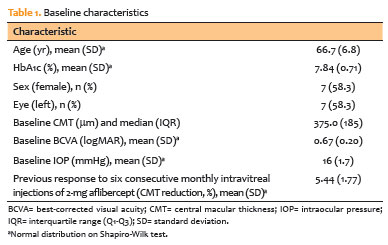
METHODS: This prospective, non-randomized, Phase 2 pilot study enrolled 12 pseudophakic eyes with diabetic macular edema refractory to anti-vascular endothelial growth factor (anti-VEGF) therapy. Participants underwent a challenge phase (Day 0) consisting of a single intravitreal injection of 0.08-mg dexamethasone sodium phosphate, followed by a maintenance phase (Day 7), during which all subjects received a 0.7-mg dexamethasone implant. The primary outcome was concordance between the anatomical response at Day 3 (post-dexamethasone sodium phosphate) and Day 60 (post-implant), defined as a ≥10% reduction in central macular thickness. Secondary outcomes included achieving a clinically "dry" macula (central macular thickness ≤300 μm) at Day 60, changes in best-corrected visual acuity, safety outcomes (intraocular pressure), and spectral-domain optical coherence tomography biomarker analysis.
RESULTS: The dexamethasone sodium phosphate challenge induced significant macular drying by Day 3 (median central macular thickness reduction, −21 μm; p=0.002). A positive response to dexamethasone sodium phosphate strongly predicted response to the dexamethasone implant, with a positive predictive value and specificity of 100%. The negative predictive
value was 80%. Irreversible biomarkers, including disorganization of retinal inner layers and ellipsoid zone disruption, were more prevalent among nonresponders (60% vs. 28.6%). Safety outcomes were acceptable; 16.7% of patients developed ocular hypertension, which was successfully managed with topical therapy.
CONCLUSION: A short-term dexamethasone sodium phosphate challenge is a safe,
low-cost, and highly specific predictor of dexamethasone implant efficacy. This "test-and-treat" strategy may optimize resource allocation in resource-constrained settings by identifying responders before high-cost implantation.
Keywords: Diabetic retinopathy; Macular edema; Dexamethasone; Drug implants; Biomarkers, pharmacological


 ABO is licensed under a Creative Commons Attribution-NonComercial 4.0 Internacional.


08-tab01.jpg)