Arq. Bras. Oftalmol. 2025;88 (1 )
:1-8
| DOI: 10.5935/0004-2749.2023-0103
Abstract
PURPOSE: This study aimed to compare the safety and effectiveness of intraocular pressure reduction between micropulse transscleral cyclophotocoagulation and “slow cook” transscleral cyclophotocoagulation in patients with refractory primary open-angle glaucoma.
METHODS: We included patients with primary open angle glaucoma with at least 12 months of follow-up. We collected and analyzed data on the preoperative characteristics and postoperative outcomes. The primary outcomes were a reduction of ≥20% of the baseline value (criterion A) and/or intraocular pressure between 6 and 21 mmHg (criterion B).
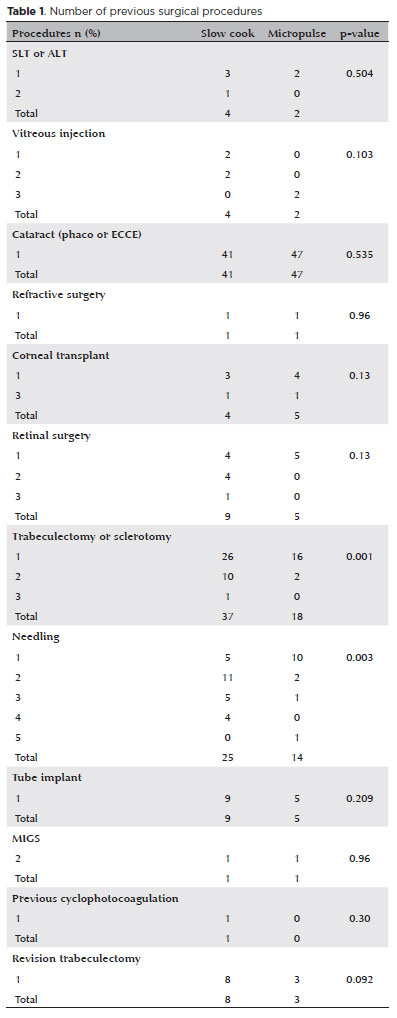
RESULTS: We included 128 eyes with primary open-angle glaucoma. The preoperative mean intraocular pressure was 25.53 ± 6.40 and 35.02 ± 12.57 mmHg in the micropulse- and “slow cook” transscleral cyclophotocoagulation groups, respectively (p<0.001). The mean intraocular pressure was reduced significantly to 14.33 ± 3.40 and 15.37 ± 5.85 mmHg in the micropulse- and “slow cook” transscleral cyclophotocoagulation groups at the last follow-up, respectively (p=0.110). The mean intraocular pressure reduction at 12 months was 11.20 ± 11.46 and 19.65 ± 13.22 mmHg in the micropulse- and “slow cook” transscleral cyclophotocoagulation groups, respectively (p<0.001). The median preoperative logMAR visual acuity was 0.52 ± 0.69 and 1.75 ± 1.04 in the micropulse- and “slow cook” transscleral cyclophotocoagulation groups, respectively (p<0.001). The mean visual acuity variation was -0.10 ± 0.35 and -0.074 ± 0.16 in the micropulse- and “slow cook” transscleral cyclophotocoagulation, respectively (p=0.510). Preoperatively, the mean eye drops were 3.44 ± 1.38 and 2.89 ± 0.68 drugs in the micropulse- and “slow cook” transscleral cyclophotocoagulation groups, respectively (p=0.017), but those were 2.06 ± 1.42 and 1.02 ± 1.46 at the end of the study in the slow cook” and micropulse transscleral cyclophotocoagulation groups, respectively (p<0.001). The success of criterion A was not significant between both groups. Compared with 11 eyes (17.74%) in the slow cook” transscleral cyclophotocoagulation group, 19 eyes (28.78%) in the micropulse transscleral cyclophotocoagulation group showed complete success (p=0.171). For criterion B, 28 (42.42%) and 2 eyes (3.22%) showed complete success after micropulse- and slow cook” transscleral cyclophotocoagulation, respectively (p<0.001).
CONCLUSION: Both techniques reduced intraocular pressure effectively.
Keywords: Sclera/surgery; Glaucoma, open-angle/surgery; Ciliary body/surgery; Intraocular pressure; Laser coagulation/methods; Lasers, semiconductor; Comparative study; Effectiveness
Arq. Bras. Oftalmol. 2026;89 (5 )
:1-6
| DOI: 10.5935/0004-2749.2026-0019
Abstract
PURPOSE:To evaluate ocular findings in children born to mothers who were infected with severe acute respiratory syndrome coronavirus 2 (SARS-CoV-2) during pregnancy.
METHODS: This prospective observational study was conducted in Brasília, Brazil, between October 2020 and 2021. Children born to mothers with laboratory-confirmed SARS-CoV-2 infection during pregnancy were included and compared with a control group of nonexposed children. All participants underwent a comprehensive ophthalmological examination performed by pediatric ophthalmologists, including assessment of ocular motility, slit-lamp biomicroscopy, cycloplegic refraction, intraocular pressure measurement, central corneal pachymetry, indirect ophthalmoscopy, and retinal imaging. Maternal and neonatal clinical data were also collected. Ocular parameters were compared between the exposed and control groups.
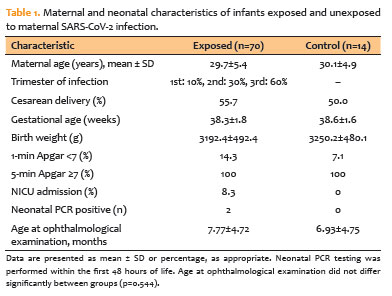
RESULTS: A total of 84 children were evaluated, including 70 exposed to maternal SARS-CoV-2 infection and 14 nonexposed controls. The mean gestational age was 38.3±1.8 weeks, and the mean birth weight was 3,192±492 g. No significant differences were observed between the groups in terms of ocular motility, anterior or posterior segment findings, intraocular pressure, central corneal thickness, or refractive status. Isolated findings, including epicanthus and congenital ptosis, were observed in a small number of children but were not significantly associated with maternal SARS-CoV-2 infection.
CONCLUSIONS: In this prospective cohort, no significant ocular abnormalities were identified in children exposed in utero to maternal SARS-CoV-2 infection compared with nonexposed controls. However, the relatively small and unbalanced control group limits the strength of these findings, which should not be interpreted as evidence that maternal SARS-CoV-2 infection does not affect ocular development. Larger prospective studies with adequately sized and balanced comparison groups are warranted to further investigate the potential ocular effects of prenatal SARS-CoV-2 exposure.
Keywords: COVID-19; SARS-CoV-2; Pregnancy; Infants; Ocular findings; Vertical transmission; Ophthalmology


 ABO is licensed under a Creative Commons Attribution-NonComercial 4.0 Internacional.