Arq. Bras. Oftalmol. 2017;80 (1 )
:1-3
| DOI: 10.5935/0004-2749.20170002
Abstract
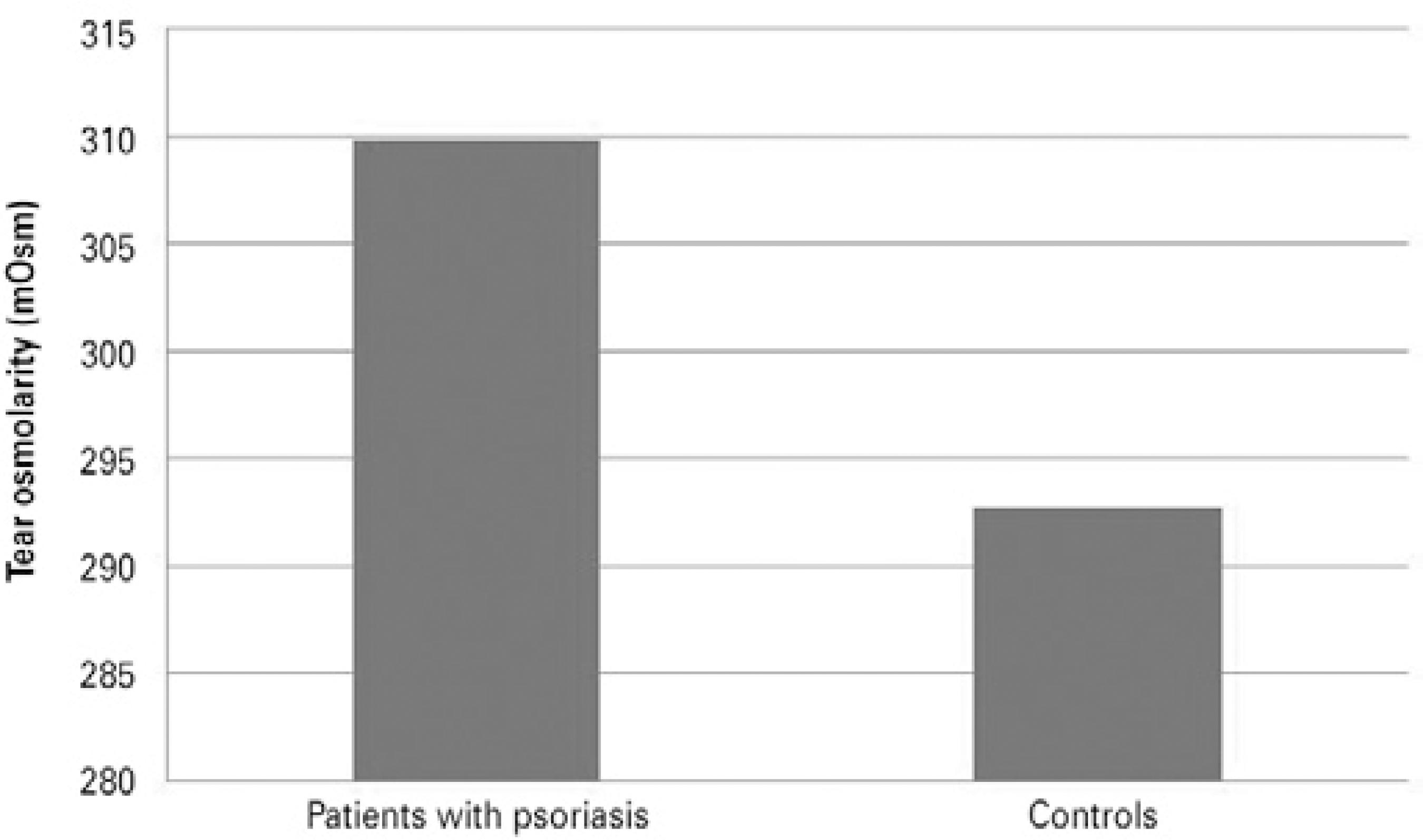
Objetivo: O objetivo deste estudo foi avaliar a osmolaridade da lágrima, função do filme lacrimal e alterações da superfície ocular em pacientes com psoríase. Método: Em um único centro, 30 olhos de 30 pacientes com psoríase (grupo 1) e 30 olhos de 30 indivíduos saudáveis (grupo 2) foram avaliados pelo questionário do Índice de Doença da Superfície Ocular (OSDI), teste de Schirmer tipo I, tempo de ruptura do filme lacrimal (TBUT), coloração por fluoresceína da superfície ocular utilizando a escala de Oxford modificada e osmolaridade lacrimal. Resultados: Os valores de osmolaridade lacrimal, OSDI e escores da escala de Oxford foram significativamente maiores no grupo 1 (309,8 ± 9,4 mOsm, 38,9 ± 1,1 e 0,7 ± 1,1, respectivamente) em comparação com o grupo 2 (292,7 ± 7,7 mOsm, 4,2 ± 0,3 e 0,1 ± 0,3, respectivamente) (p<0,01 para todos). TBUT no grupo 1 (8,7 ± 3,6 s) foi significativamente menor em comparação com o grupo 2 (18,1 ± 2,8 s) (p<0,001). Não foram detectadas diferenças significativas nos valores de teste de Schirmer (16,2 ± 2,5 mm no grupo 1 e 16,6 ± 2,3 mm no grupo 2, p=0,629). Conclusões: Este estudo mostrou que a psoríase pode influenciar osmolaridade lágrima e função do filme lacrimal. Os pacientes com psoríase apresentaram hiperosmolaridade lágrima e disfunção do filme lacrimal.
Keywords: Síndromes do olho seco; Lágrima; Concentração osmolar; Psoríase; Filme lacrimal
Arq. Bras. Oftalmol. 2024;87 (2 )
:1-5
| DOI: 10.5935/0004-2749.2023-0001
Abstract
PURPOSE: To investigate the clinical benefits of the co-application of bevacizumab and tissue plasminogen activator as adjuncts in the surgical treatment of proliferative diabetic retinopathy.
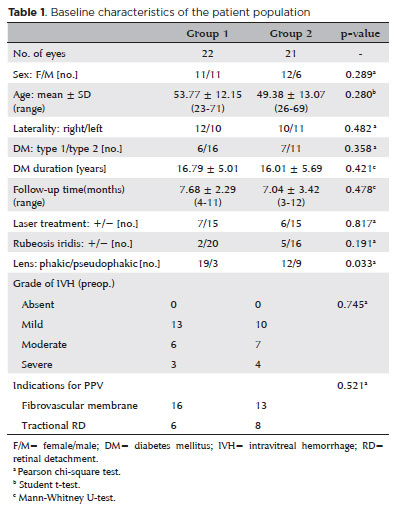
METHODS: Patients who underwent vitrectomy for proliferative diabetic retinopathy complications were preoperatively given intravitreal injection with either bevacizumab and tissue plasminogen activator (Group 1) or bevacizumab alone (Group 2). Primary outcomes were surgery time and number of intraoperative iatrogenic retinal breaks. Secondary outcomes included changes in the best-corrected visual acuity and postoperative complications at 3 months postoperatively.
RESULTS: The mean surgery time in Group 1 (52.95 ± 5.90 min) was significantly shorter than that in Group 2 (79.61 ± 12.63 min) (p<0.001). The mean number of iatrogenic retinal breaks was 0.50 ± 0.59 (0-2) in Group 1 and 2.00 ± 0.83 (0-3) in Group 2 (p<0.001). The best-corrected visual acuity significantly improved in both groups (p<0.001). One eye in each group developed retinal detachment.
CONCLUSION: Preoperative co-application of bevacizumab and tissue plasminogen activator as adjuncts in the surgical treatment of proliferative diabetic retinopathy shortens the surgery time and reduces the number of intraoperative iatrogenic retinal breaks.
Keywords: Diabetic retinopathy; Bevacizumab; Plasminogen activators; Vitrectomy; Operative time


 ABO is licensed under a Creative Commons Attribution-NonComercial 4.0 Internacional.