Arq. Bras. Oftalmol. 2020;83 (2 )
:92-97
| DOI: 10.5935/0004-2749.20200015
Abstract
Objetivo: Analisar os índices subclínicos de topografia de ceratocone utilizando as medidas feitas com Pentacam e com Orbscan-II para identificar evidências para a busca de índices sensíveis para triagem e diagnóstico de ceratocone subclínico.
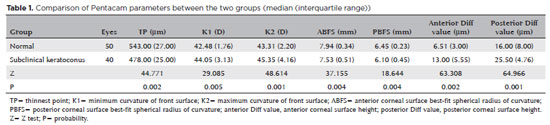
Métodos: Cinquenta participantes saudáveis (50 olhos) e 40 pacientes com ceratocone subclínico (40 olhos) foram incluídos. Sete parâmetros comuns, incluindo a espessura da córnea no ponto mais fino; a curvatura mínima da superfície frontal (valor mínimo da ceratometria simulada, Min de SimK); a curvatura máxima da superfície frontal (valor máximo da ceratometria simulada, Max de SimK); a superfície frontal e a superfície posterior da córnea de melhor ajuste ao raio da curvatura, a altura da superfície anterior da córnea (valor Diff anterior) e a altura da superfície corneana posterior (valor Diff posterior) medidos pelo Pentacam e pelo Orbscan-II entre os olhos normais e com ceratocone subclínico foram comparados.
Resultados: As diferenças estatísticas entre os grupos saudável e com ceratocone subclínico (p<0,01) foram encontradas em todos os parâmetros corneanos medidos usando ambos os dispositivos. Diferenças na curvatura mínima da superfície frontal (Min de SimK) no ponto mais fino, no valor Diff anterior e no valor Diff posterior foram significativas entre Pentacam e Orbscan-II no grupo com ceratocone subclínico (p<0,05).
Conclusão: Os achados deste estudo identificam as diferenças entre olhos normais e com ceratocone subclínico para a curvatura mínima da superfície frontal, a curvatura máxima da superfície frontal, a superfície corneana frontal e a superfície corneana posterior de melhor ajuste ao raio esférico da curvatura e as medidas de Diff anterior e posterior usando Orbscan II e o Pentacam que podem auxiliar os profissionais de oftalmologia a diagnosticar clinicamente o ceratocone subclínico.
Keywords: Ceratocone/diagnóstico; Topografia da córnea; Córnea/ diagnóstico por imagem; Diagnóstico por imagem/métodos; Estudo comparativo
Arq. Bras. Oftalmol. 2025;88 (4 )
:1-7
| DOI: 10.5935/0004-2749.2023-0356
Abstract
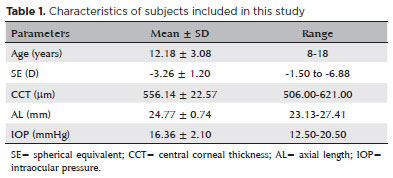
PURPOSE: Although the orthokeratology effects on corneal biomechanics have been proven with clinical trials, reports of stiffness parameter change are scarce. This study investigated the short-term orthokeratology effects in pediatric myopia and compared stiffness parameter changes to those published in recent clinical investigations. This prospective study aimed to investigate corneal biomechanics changes induced by short-term overnight orthokeratology treatment, focusing on stiffness parameter at A1 and stress-strain index
METHODS: Twenty-six children aged 8 to 18 were included in this study using orthokeratology lenses for two different durations: 1 day and 1 week. Corneal biomechanics were assessed using corneal visualization (Corvis) Scheimpflug technology. Measurements were taken at baseline and after each wearing session. Changes in corneal stiffness parameters and corneal curvature were analyzed.
RESULTS: All parameters changed significantly after 1 week of lens wear (p<0.05), except for velocity of corneal apex at the first and second applanation times highest concavity time, radius, stiffness parameter at A1 and stress-strain index. After 1 day, central corneal thickness, first applanation time, second applanation time, deformation amplitude ratio (2 mm), and Corvis biomechanical index (CBI) remained stable (p>0.05). After 1 week, central corneal thickness and first applanation time decreased, whereas second applanation time, deformation amplitude ratio, and Corvis Biomechanical Index significantly increased. With intraocular pressure and central corneal thickness as control variables, no significant correlation was found between stress-strain index and curvature changes (p>0.05). With age as the control variable, no significant correlation was found between stress-strain index and curvature changes (p>0.05).
CONCLUSIONS: Short-term orthokeratology treatment induced notable changes in several corneal biomechanical parameters. Stiffness parameter at A1 and stress-strain index are unaffected by increasing lens wear duration and do not influence the orthokeratology effect.
Keywords: Orthokeratologic procedures; Epithelium, corneal; Corneal topography; Myopia/therapy; Diagnostic techniques, ophthalmological; Biomechanical phenomena; Refraction, ocular; Visual acuity; Humans; Children; Adolescent


 ABO is licensed under a Creative Commons Attribution-NonComercial 4.0 Internacional.