
Arq. Bras. Oftalmol. 2026; 89 (4): 10.5935/0004-2749.2026-0090
Total: 790
Felipe Augusto Casseb dos Santos1; João Victor Tenório Lossio de Macedo1; Daniel Haruo Ishigai1; Bernardo Kaplan Moscovici2,3; Ricardo Menon Nosé1
DOI: 10.5935/0004-2749.2026-0090
Dear Editor:
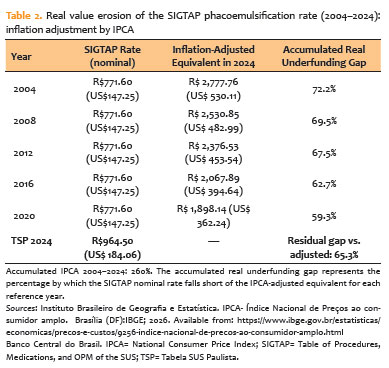
Cataract surgery is the ophthalmic procedure with the greatest social impact in Brazil, and its sustainable provision within the Unified Health System [Sistema Único de Saúde (SUS)] depends directly on adequate federal reimbursement. However, the reimbursement rate established by the Procedure, Medication, and OPM Management System [Sistema de Gerenciamento da Tabela de Procedimentos, Medicamentos e OPM (SIGTAP)] for phacoemulsification with foldable intraocular lens (IOL) implantation has remained nominally unchanged at R$ 771.60 (approximately US$ 147.00 at current exchange rates) since 2004. When adjusted for the 260% cumulative National Broad Consumer Price Index (Índice Nacional de Preços ao Consumidor Amplo [IPCA]), this amount would correspond to R$ 2,777.76 (US$ 530.00) in 2024, revealing a structural underfunding gap of 72.2%.
In response to this longstanding deficit, the State of São Paulo enacted Resolution SS No. 198/2023, establishing the São Paulo State SUS Table [Tabela SUS Paulista (TSP)], a supplementary state-level reimbursement mechanism applicable to all health establishments, regardless of nonprofit status, participating in the SUS in the state of São Paulo(1). Operationally, the TSP supplement is funded exclusively by the São Paulo State Treasury and is calculated based on each institution’s SUS-approved production recorded in the national SUS information systems, namely the Hospital Information System [Sistema de Informações Hospitalares do SUS (SIH/SUS) ] and the Outpatient Information System [Sistema de Informações Ambulatoriais do SUS (SIA/SUS)]. Importantly, there is no individual negotiation of reimbursement rates; instead, the TSP establishes uniform supplementary percentages for each procedure code, which are applied equally to all eligible institutions(1). We analyzed the financial impact of this policy on cataract surgery at the Irmandade da Santa Casa de Misericórdia de São Paulo (ISCMSP), a philanthropic institution and one of the largest SUS providers in Brazil, using 2024 production data obtained from the SIH/SUS database maintained by the Department of Informatics of the Unified Health System [Departamento de Informática do Sistema Único de Saúde (DATASUS)].
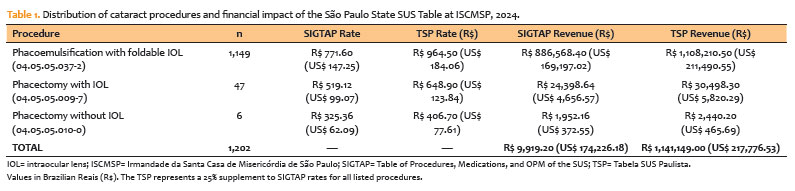
A total of 1,202 cataract procedures were performed in 2024, of which 95.6% were phacoemulsification procedures with foldable IOL implantation (n=1,149). The TSP provided a uniform 25% supplement to SIGTAP reimbursement rates for all procedure codes, increasing gross revenue from R$ 912,919.20 (US$ 174,220) to R$ 1,141,149.00 (US$ 217,850), corresponding to an absolute annual increase of R$ 228,229.80 (US$ 43,560; Table 1). Surgical volume increased by 44.0% compared with 2022 (n=835), despite a 16.8% reduction in 2023 (n=695). Paradoxically, this growth occurred despite chronic reimbursement underfunding. Historically, the determining factor has been public financing rather than reimbursement adequacy. As documented by Kara-Junior, cataract surgery volumes in Brazil have increased or decreased primarily in response to federal funding policies and parliamentary amendments, rather than adjustments in reimbursement rates(2,3). This pattern underscores that barriers to access are predominantly institutional and financial and that increased surgical output can coexist with, and may reflect, providers’ adaptation to structurally insufficient reimbursement(4).
Despite this meaningful institutional gain, the TSP reimbursement rate of R$ 964.50 (US$ 184.00) represents only 34.7% of the inflation-adjusted 2004 value, leaving a residual underfunding gap of 65.3% (Table 2). This finding places the policy in its proper context: although the TSP represents a significant and welcome advance, it mitigates rather than resolves the structural deficit that has been documented in the national literature for more than two decades. Kara-Junior and Rossi et al. demonstrated that governmental reimbursement remains insufficient even at centers of excellence and that public investment has consistently been the decisive factor influencing surgical volume in Brazil(3).
Importantly, this underfunding dynamic is not restricted to the public sector. Private health insurers in Brazil have historically reimbursed providers according to proprietary fee schedules or outdated editions of the Brazilian Hierarchical Classification of Medical Procedures (Classificação Brasileira Hierarquizada de Procedimentos Médicos [CBHPM]), which are rarely adjusted for inflation. The Brazilian Federal Council of Medicine has documented reimbursement gaps of up to 17,270% between SUS procedure payments and current CBHPM values(5). In this context, the significance of the TSP extends beyond its immediate fiscal impact. The official recognition by the State of São Paulo that R$ 771.60 (US$ 147.00) is insufficient to cover the operating costs of phacoemulsification establishes a concrete, government-endorsed precedent for reimbursement negotiations between ophthalmology providers and private insurers, which face a structurally similar challenge.
In conclusion, the TSP demonstrated a positive and immediate financial impact at ISCMSP in 2024. These findings confirm that cataract surgery underfunding is a systemic issue affecting both the SUS and the private health insurance sector. State-level supplementary initiatives such as the TSP provide not only institutional financial relief but also a legitimate evidence base to support broader revisions of ophthalmologicalophthalmic reimbursement policies in Brazil.
AUTHORS’ CONTRIBUTIONS:
Significant contribution to conception and design: Felipe Augusto Casseb dos Santos; João Victor Tenório Lossio de Macedo; Daniel Haruo Ishigai. Data Acquisition: Felipe Augusto Casseb dos Santos; João Victor Tenório Lossio de Macedo. Data Analysis and Interpretation: Felipe Augusto Casseb dos Santos; João Victor Tenório Lossio de Macedo. Manuscript Drafting: Felipe Augusto Casseb dos Santos; João Victor Tenório Lossio de Macedo. Significant intellectual content revision of the manuscript: Daniel Haruo Ishigai; Bernardo Kaplan Moscovici; Ricardo Menon Nosé. Final approval of the submitted manuscript: Felipe Augusto Casseb dos Santos; João Victor Tenório Lossio de Macedo; Daniel Haruo Ishigai; Bernardo Kaplan Moscovici; Ricardo Menon Nosé. Statistical analysis: not applicable. Obtaining funding: not applicable. Supervision of administrative, technical, or material support: Daniel Haruo Ishigai. Research group leadership: Felipe Augusto Casseb dos Santos.
REFERENCES
1. São Paulo (Estado). Secretaria da Saúde. Resolução nº 198, de 29 de dezembro de 2023. Disciplina a aplicação da tabela SUS Paulista aos estabelecimentos de saúde, com ou sem fins lucrativos, que participaram do Sistema Único de Saúde, de forma complementar para assistência á saúde aos usuários do SUS/SP. Diário Oficial do Estado de São Paulo [Internet]. 23 de setembro de 2024 [cited 2025 Jul 21]. Available from: https://doe.sp.gov.br/executivo/secretaria-da-saude/resolucao-n-198-de-29-de-dezembro-de-2023-2024092011361220602193
2. Rossi S, Jorge PA, Scherer R, Kara-Junior N. Progression in the number of cataract surgeries in Brazil: 10 years of evolution. Ophthalmic Epidemiol. 2025;32(3):285-92.
3. Kara-Junior N, Rossi S. Epidemiology of cataract-related blindness in Brazil: 30 years of public policy Evolution: a review article. Am J Ophthalmol. 2025;273:205-11.
4. Kara-Junior N. Are cataract surgery campaigns necessary for preventing blindness in developing countries? Arq Bras Oftalmol. 2025;88(4):e20241016.
5. Conselho Federal de Medicina. Defasagem em valores pagos é de até 17 mil% [Internet]. Brasília: CFM; 25 de novembro de 2022.[cited 2026 Feb 23]. Available from: https://portal.cfm.org.br/noticias/defasagem-em-valores-pagos-e-de-ate-17-mil
Submitted for publication:
March 10, 2026.
Accepted for publication:
June 9, 2026.
Data Availability Statement: All the content of the publication is already available at the time of the submission in public domain.
Edited by
Editor-in-Chief: Newton Kara-Júnior
Funding: This study received no specific financial support.
Disclosure of potential conflicts of interest: The authors declare no potential conflicts of interest.

How to cite this article:
 ABO is licensed under a Creative Commons Attribution-NonComercial 4.0 Internacional.