Showing of 1 until 15 from 77 result(s)
Search for: Strabismus; Myopia; Exotropia; Esotropia; Surgery
Abstract
Objetivo: Avaliar os resultados clínicos da ceratectomia fotorrefrativa associada à ceratotomia lamelar pediculada (LASIK), para miopia moderada e alta, com ou sem secagem do leito estromal durante a foto-ablação. Pacientes e Métodos: Estudo retrospectivo de 39 olhos de 30 pacientes submetidos a LASIK sem secagem do leito estromal durante a foto-ablação no período de abril de 1996 a abril de 1997 (Grupo I) e 42 olhos de 28 pacientes com secagem do leito estromal durante a foto-ablação a cada 80 pulsos, no período de abril de 1997 a setembro de 1997 (Grupo II). Após a ceratotomia lamelar pediculada corneana com um microcerátomo automatizado (Chiron Corneal Shaper ®), foi realizada a foto-ablação com excimer laser de fluoreto de argônio de 193 nm da Summit modelo Apex Plus®. Em 2 olhos do Grupo I, a foto-ablação não foi realizada, devido a complicações durante a ceratotomia lamelar. Resultados: O tempo médio de seguimento pós-operatório foi de 8,7 meses no Grupo I e 7,7 meses no Grupo II. A média de tratamento foi de -10,81D (±2,38) no grupo I e -8,73D (±2,82) no grupo II. As médias das variações dos equivalentes esféricos obtidos em relação ao tratamento desejado nos meses 1, 3, 6 e 12 foram respectivamente, -0,96D (±1,19), -1,19D (±1,37), -1,06D (±1,41) e -1,10D (±0,66) no Grupo I e -0,23D (±1,02), -0,41D (±1,34), -0,75D (±1,16) e -1,03D (±1,31) no Grupo II. Três olhos do total (3,7%), todos do Grupo I, perderam 2 ou mais linhas de visão. Na visita mais recente, 17 olhos (45,9%) do Grupo I e 31 olhos (73,8%) do Grupo II apresentaram Acuidade Visual sem correção de 20/40 ou melhor. Ocorreram 4 complicações intra-operatórias no grupo I, sendo que 2 casos tiveram a foto-ablação não-efetuada e uma complicação intra-operatória no Grupo II. Conclusão: A secagem do leito estromal possibilitou recuperação visual mais rápida, devido a menor hipocorreção primária. O seguimento a longo prazo não evidenciou diferenças estatisticamente significantes entre os dois tratamentos.
Keywords: Miopia, cirurgia p.; Laser, cirurgia de; LASIK

Abstract
PURPOSE: This study aimed to identify the strategies adopted by Brazilian ophthalmologists to control myopia in clinical practice.
METHODS: This was a prospective cross-sectional study. Data were collected using an online questionnaire.
RESULTS: Responses from 148 participants were collected between March and May 2024. The majority of respondents were general ophthalmologists (51%) and pediatric ophthalmologists (43%). They came from all regions of Brazil, but more than half (52%) were from the Southeast region. Most participants (30%) had over 20 years of clinical practice experience. A significant proportion (89.2%) treated progressive myopia. The most requested complementary exams were optical biometry (83.78%) and corneal topography or tomography (69.59%). Behavioral measures were considered the most effective myopia treatment strategies by 41.2% of the respondents, followed by optical (33.8%) and pharmacological interventions (25%). Most recommended spending more time outdoors (94.59%) and reducing screen time (93.92%). Spectacle lenses for myopia (83.11%) and 0.025% atropine eye drops (54.73%) were the most prescribed treatments after the recommendation of environmental and behavioral changes.
CONCLUSION: This study presents a novel analysis of the clinical strategies for myopia control among Brazilian ophthalmologists. Understanding current clinical practices and identifying possible improvements are essential steps toward developing evidence-based guidelines and professional education aimed at improving patient care.
Keywords: Myopia/epidemiology; Refractive errors; Contact lenses; Myopia/drug therapy; Atropine/therapeutic use; Ophthalmologists; Practice patterns, physicians’; Surveys and questionnaires; Brazil/epidemiology
Abstract
OBJETIVO: Avaliar a relação entre alterações na hipermetropia e o alinhamento ocular em pacientes com esotropia acomodativa.
MÉTODOS: Foram analisados retrospectivamente prontuários médicos de pacientes consecutivos diagnosticados com esotropia acomodativa refrativa (com esotropia eliminada ou reduzida a menos de 10 D com correção completa da hipermetropia). As medidas de refração em cicloplegia obtidas dos prontuários foram convertidas em equivalentes esféricos. Avaliaram-se ainda a presença de ambliopia, alterações do erro refrativo e o alinhamento ocular à admissão e depois do período de acompanhamento.
RESULTADOS: Setenta pacientes (média de idade=6,01 ± 5,41 anos, 60,6% do sexo feminino, acompanhamento médio de 5,8 ± 3 anos) apresentaram esotropia de 40 ± 20 dioptrias prismáticas (DP) para perto à admissão. A diminuição média anual no desvio para perto e para longe com o uso de óculos foi de 1,71 ± 3,96 DP/ano e 1,09 ± 3,25 DP/ano, respectivamente. Os desvios miópicos totais dos olhos direito e esquerdo foram de 1,08 ± 1,35 D e 1,20 ± 1,40 D, respectivamente. Os desvios miópicos anuais foram de 0,22 D/ano e 0,26 D/ano para os olhos direito e esquerdo, respectivamente. A correlação entre a taxa de desvio miópico e a taxa de alteração do desvio para perto corrigido foi fraca. A correlação da taxa de desvio miópico não foi alta para os olhos direito e esquerdo (r=0,18, p=0,15).
CONCLUSÃO: A quantidade de desvio e a hipermetropia diminuem gradualmente na esotropia acomodativa durante o acompanhamento. Por outro lado, pode não ser apropriado garantir aos pacientes que o desvio diminuirá em paralelo ao erro refrativo.
Keywords: Ambliopia; Acomodação ocular; Esotropia; Refração ocular
Abstract
PURPOSE: This study aimed to examine the prevalence of myopic eyes over 11 years (2008-2018) in a private clinic and a public assistance service.
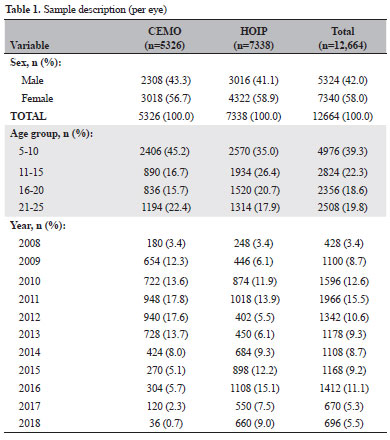
METHODS: We retrospectively evaluated 6332 individuals (12,664 eyes)
between 5 and 25 years old, seen at a private clinic-CEMO (2,663 individuals) and a public service-HOIP (3,669 individuals) from 2008 to 2018. We evaluated the prevalence of myopic eyes (EE ≤-0.50) and high myopic eyes (EE ≤-6.00).
RESULTS: Sex and services did not show statistical differences. The variation in the prevalence of myopic and high myopic eyes showed a random pattern during the study period (this prevalence could not be increased). Prevalences ranged from 20.7% (in 2017) to 32.4% (in 2015) for myopic eyes and from 1.6% (in 2009 and 2016) to 3.3% (in 2015) for eyes with high myopia. The prevalence of myopia showed a statistically significant increase based on the age group.
CONCLUSION: The prevalence of myopic eyes did not increase in our study. The mean prevalence of myopic eyes was similar in the private clinic and public service.
Keywords: Myopia; Refractive errors; Epidemiology; Prevalence
Abstract
Objetivo: Avaliar o desempenho clínico do Spot Vision Screener e estabelecer correlações clínicas entre a triagem automatizada e a retinoscopia após indução de cicloplegia em crianças pré-verbais.
Métodos: Neste estudo transversal prospectivo, crianças de 6 a 36 meses foram avaliadas usando o Spot Vision Screener. O exame oftalmológico completo, incluindo refração cicloplégica, foi então realizado, seguido de repetição da triagem automatizada e retinoscopia em todos os casos, a fim de estabelecer correlações quanto à hipermetropia, miopia e astigmatismo após a indução de cicloplegia.
Resultados: O estudo incluiu 185 crianças. A sensibilidade do dispositivo de triagem automática após cicloplegia foi de 100% (IC 95%: 85,18-100%) e a especificidade foi de 87,04% (IC 95%: 80,87-91,79%). Os valores preditivos positivos e negativos foram de 52,27% (42,36 - 62,01%) e 100%, respectivamente. Em comparação com a retinoscopia, o Spot Vision Screener superestimou os valores esféricos em 0,62 D (IC 95%: 0,56 - 0,69) no olho direito e em 0,60 (IC 95%: 0,54 - 0,66) no olho esquerdo e os valores cilíndricos em -0,38 D (IC 95%: -0,42 a -0,33) no olho direito e por -0,39 D (IC 95%: -0,43 a -0,34) no olho esquerdo. A diferença para os valores esféricos e cilíndricos de forma geral foi de 0,61 D (IC 95%: 0,57 - 0,65) e -0,38 D (IC 95%: -0,41 a -0,35), respectivamente.
Conclusão: Foi encontrada correlação substancial entre a retinoscopia e os dados objetivos captados pelo dispositivo. Isso mostra que a tecnologia pode ser usada em conjunto, contribuindo para um diagnóstico mais preciso e identificando os fatores de risco de ambliopia o mais precocemente possível. A técnica automatizada pode fazer a diferença em nível populacional para triagem e intervenção precoce.
Keywords: Erros de refração; Ambliopia; Estrabismo; Refratometria; Retinoscopia
Abstract
Objetivo: Descrição de um método simples, acessível e confiável para a medida das disfunções dos músculos oblíquos, utilizando-se smartphone.
Métodos: Foi utilizado o recurso de rotação de fotografias do aplicativo FOTOS do iPhone®; 75 examinadores avaliaram 22 fotos de 9 pacientes, obtidas em infra e supra dextroversão, infra e supra levoversão (nem todos os pacientes foram fotografados nas 4 posições citadas). Conferiu-se aos pacientes uma pontuação para a função do músculo oblíquo superior e músculo oblíquo inferior, que variou de -4 (negativo para hipofunção) a +4 (positivo para hiperfunção), ou 0 (normofuncionantes), antes e depois da edição das fotografias. Esses valores foram comparados à avaliação prévia atribuída pelos assistentes do estrabismo. Computou-se a diferença da pontuação entre eles em números naturais (inteiros e não negativos); foram calculadas média e desvio padrão dessas medidas.
Resultado: A medida da maioria das fotos editadas apresentou média inferior as não editadas, à exceção de um paciente com hiperfunção de oblíquo superior esquerdo. Pacientes sem disfunção de oblíquos demonstraram, após edição das fotos, maior similaridade com o valor inicialmente determinado (p<0,05), assim como os pacientes com oblíquo superior direito hiperfuncionantes (p<0,01). Os mesmos resultados são encontrados nos pacientes com hipofunção dos oblíquos e hiperfunção de oblíquo inferior direito (p<0,01).
Conclusão: O método utilizado para medida das funções musculares nos estrabismos verticais é reprodutível, acessível, simples, confiável, e confere maior uniformidade à aferição.
Keywords: Estrabismo; Músculo oculomotor; Anisotropia; Smartphone; Telefone celular
Abstract
PURPOSE: Amblyopia is a cortical neurological disorder caused by abnormal visual experiences during the critical period for visual development. Recent works have shown that, in addition to the well-known visual alterations, such as changes in visual acuity, several perceptual aspects of vision are affected. This study aims to analyze and compare the effects of different types of amblyopia on visual color processing and determine whether these effects are correlated with visual acuity.
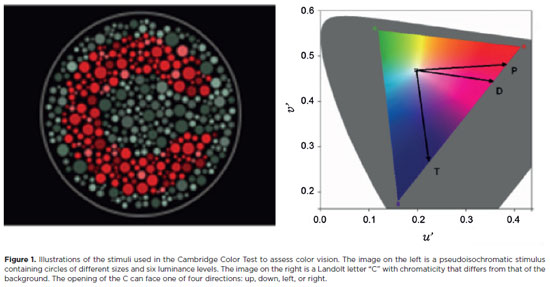
METHODS: Our study sample comprised 42 amblyopic individuals, aged 7-40 years, (strabismus, n=16; anisometropia, n=18; and mixed-cause, n=8) and 33 age-matched controls. Color vision was tested by measuring the chromaticity threshold of each patient on the protan, deutan, and tritan axes using version 02 of the Cambridge Color Test. Spatial stimulation cues were eliminated using spatial noise and luminance.
RESULTS: The color discrimination thresholds on the protan, deutan, and tritan axes were similar between control participants and amblyopic patients (p>0.05). There was no correlation between VA values and color thresholds (p>0.05).
CONCLUSION: Patients with amblyopia have normal color vision in contexts that include luminance and spatial noise. Our results may be indicative of independent neural pathways for spatial and chromatic visual processing.
Keywords: Amblyopia; Anisometropia; Color vision; Strabismus; Vision disorders; Visual acuity
Abstract
Objetivos: Blefaroptose e estrabismo podem ser coexistentes em adultos e ambos afetam a aparência estética e o domínio psicossocial. Ambos também geralmente requerem cirurgia, realizada tradicionalmente em uma abordagem sequencial. O objetivo do presente estudo foi avaliar a eficácia da execução simultânea da ressecção musculoconjuntival de Müller, com ou sem cirurgia de tarsectomia, e da cirurgia de estrabismo em pacientes adultos com ptose e estrabismo coexistentes.
Métodos: Foram retrospectivamente avaliados pacientes com ptose e estrabismo coexistentes submetidos simultaneamente à ressecção musculoconjuntival de Müller, com ou sem tarsectomia, e à cirurgia de estrabismo horizontal. A análise incluiu a mensuração do ângulo de desvio das dioptrias de prisma, a distância do reflexo à margem, a assimetria da altura palpebral e quaisquer complicações após a cirurgia. A ressecção musculoconjuntival de Müller, com ou sem sucesso na tarsectomia, foi considerada bem-sucedida com uma distância reflexo-margem medindo entre 3,5 e 5 mm, e uma diferença entre as duas pálpebras superiores menor que 1 mm. O sucesso da cirurgia de estrabismo foi definido como um alinhamento com ± 10 dioptrias prismáticas de ortotropia.
Resultados: Os pacientes foram 3 mulheres e 5 homens, com média de idade de 37,12 anos (faixa de 22 a 62 anos). A parte de estrabismo da cirurgia foi realizada primeiro em todos os pacientes. Os resultados da simetria palpebral superior foram avaliados como perfeitos (<0,5 mm) em 4 pacientes, bons (≥0,5 mm, <1 mm) em 4 pacientes e regulares (≥1 mm) em nenhum. A ressecção musculoconjuntival de Müller, com ou sem sucesso na tarsectomia, teve sucesso em 6 dos 8 pacientes (75%) e a intervenção para o estrabismo foi bem-sucedida em todos os pacientes. Não foi necessária cirurgia de revisão da pálpebra ou do estrabismo após a cirurgia simultânea em nenhum paciente.
Conclusões: A ressecção musculoconjuntival de Müller, com ou sem tarsectomia, pode ser combinada com a cirurgia de estrabismo em uma abordagem alternativa para pacientes com ptose e estrabismo coexistentes.
Keywords: Blefaroptose/cirurgia; Ambliopia; Estrabismo/cirurgia; Músculos oculomotores/cirurgia; Pálpebras; Procedimentos cirúrgicos oftalmológicos/métodos
Abstract
PURPOSE: This study aimed to evaluate the outcomes of strabismus surgical correction in patients with Down syndrome.
METHODS: We conducted a retrospective chart review of patients with Down syndrome who underwent strabismus surgery between January 1997 and May 2024 at an Ophthalmology Outpatient Clinic in São Paulo, Brazil. The data collected included age, sex, medical and ocular history, surgical details, and follow-up outcomes. The patients were categorized by strabismus type into esotropia, fourth nerve palsy, and mixed groups. Surgical success was defined as final alignment within 10Δ of orthotropia and, where applicable, whether there was resolution of abnormal head posture of ocular origin. Patients with postoperative follow-up <6 months were excluded.
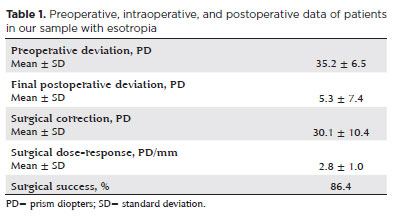
RESULTS: A total of 37 patients (21 females) were included. Of these, 22 (59.5%) were in the esotropia group, 10 (27.0%) in the fourth nerve palsy group, and 5 (13.5%) in the mixed group. The surgical success rate in the esotropia group was 86.4%, with a mean preoperative deviation of 35.2 (± 6.5)Δ, and mean surgical correction of 30.1 (± 10.4)Δ. The success rate in the fourth nerve palsy group was 40.0%, with a mean preoperative deviation of 10.4 (± 4.3)Δ. Overall, success was achieved with a single surgical procedure in 73.0% of the sample. No significant associations were found between surgical success and the clinical and demographic variables, including sex, age at surgery, oblique muscle overaction, pattern strabismus, visual acuity, amblyopia, preoperative deviation, or postoperative follow-up duration (p>0.05).
CONCLUSIONS: When standard surgical tables are applied, strabismus surgery in patients with Down syndrome appears to be safe and effective. We found high success rates, particularly among patients with esotropia. We observed no tendencies toward over- or under-correction. These findings support the use of conventional surgical protocols with this patient population.
Keywords: Down Syndrome/complications; Strabismus/surgery; Esotropia/surgery; Oculomotor nerve diseases/physiopathology; Vision disorders; Humans; Brazil.
Abstract
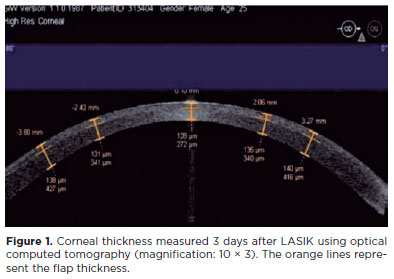
PURPOSE: Myopia, or nearsightedness, is one of the most common eye conditions worldwide. However, a comparison of the effectiveness of different laser-assisted interventions is lacking. Thus, we aimed to compare the efficacy and safety of LASIK and IntraLASIK in addressing myopia.
METHODS: The study was conducted in two ophthalmology clinics in Beijing, China, in 2022. A total of 84 patients (152 eyes) with different degrees of myopia were examined and underwent LASIK (n=46, 80 eyes) or IntraLASIK (n=38, 72 eyes). Keratometry, corneal topography, pachymetry, visual acuity evaluation, and corneal biomechanical analysis were performed before and after the intervention.
RESULTS: IntraLASIK produced more precise flaps than LASIK, with deviations of <8 mm and 0.1 mm from the intended thickness and diameter, respectively. LASIK resulted in nonuniform flaps, with thickness deviations of 5-86 mm. IntraLASIK demonstrated a superior efficacy for patients with severe myopia and thin corneas, with a mean spherical equivalent of 0.9 D at 6 months compared to the 1.4 D for LASIK. Approximately 91% and 83% of the patients with mild to moderate and severe myopia, respectively, achieved results within ± 0.49 D from the refractive target with IntraLASIK.
CONCLUSIONS: Corneal hysteresis and corneal resistance factor decreased with an increase in laser intensity, and they decreased faster with thinner corneas. Thus, IntraLASIK is more useful than LASIK in patients with thin corneas and severe myopia.
Keywords: Myopia; Lasers; Cornea; Keratomileusis; Laser in situ
Abstract
PURPOSE: This study evaluated rates of thyroid eye disease-related eyelid surgeries, strabismus surgeries, and orbital decompressions in active thyroid eye disease patients treated with teprotumumab compared to those who were not.
METHODS: In this single-center longitudinal study, we compared patients with active thyroid eye disease evaluated from 02/01/2017 to 01/31/2020 (pre-teprotumumab era) with those seen from 02/01/2020 to 04/30/2023 (teprotumumab era). Patients from the pre-teprotumumab era who received corticosteroids and/or orbital radiation were compared with those in the teprotumumab era treated with teprotumumab, with or without corticosteroids and/or orbital radiation. The primary outcomes were rates of orbital decompressions, strabismus surgery, and eyelid surgery among patients with at least 6 months of follow-up. Orbital decompressions involving two or more walls were classified as severe.
RESULTS: Of 486 records reviewed, 106 patients had active thyroid eye disease. Among them, 33 were from the pre-teprotumumab era; 22 received corticosteroids and/or orbital radiation, and 11 received no treatment. Seventy three patients were from the teprotumumab era; 37 received teprotumumab (with or without corticosteroids and/or orbital radiation), 10 received corticosteroids and/or orbital radiation alone, and 26 received no treatment. Demographics were comparable between groups. Orbital decompression was performed in 11 of 44 eyes (25.0%) in the pre-teprotumumab era treated with corticosteroids and/or orbital radiation (8 one-wall, 3 ≥two-wall), compared to 3 of 74 eyes (4.1%) in the teprotumumab era treated with teprotumumab with or without corticosteroids and/ or orbital radiation (all one-wall). The overall rate of orbital decompressions and the rate of ≥two-wall decompressions were significantly lower in the teprotumumab era (p=0.02 and p=0.0496, respectively). There was no significant difference in one-wall decompressions between era (p=0.07). Rates of strabismus surgeries (27.3% vs. 13.5%, p=0.19) and eyelid surgeries (22.7% vs. 21.6%, p=0.92) did not significantly differ between the era.
CONCLUSIONS: In patients with active thyroid eye disease, treatment with teprotumumab was associated with a significantly lower rate and severity of orbital decompressions compared to treatment with corticosteroids and/or orbital radiation alone. However, the rates of strabismus and eyelid surgeries remained similar between groups.
Keywords: Teprotumumab; Adrenal cortex hormone; Decompression; Graves ophthalmopathy; Strabismus
Abstract
PURPOSE: To compare inferomedial wall orbital decompression to balanced medial plus lateral wall orbital decompression in patients with Graves’ orbitopathy in the inactive phase with regard to exophthalmos reduction and the effects on quality of life.
METHODS: Forty-two patients with inactive Graves’ orbitopathy were randomly divided into two groups and submitted to one of two orbital decompression techniques: inferomedial wall orbital decompression or medial plus lateral wall orbital decompression. Preoperative and postoperative assessments included Hertel’s exophthalmometry and a validated Graves’ orbitopathy quality of life questionnaire. The results of the two groups were compared.
RESULTS: Compared to preoperative measurement, exophthalmos reduction was statistically significant in both groups (p<0.001) but more so in patients undergoing medial plus lateral wall orbital decompression (p=0.010). Neither orbital decompression techniques increased the visual functioning subscale score on the Graves’ orbitopathy quality of life questionnaire (inferomedial wall orbital decompression p=0.362 and medial plus lateral wall orbital decompression p=0.727), but a statistically significant difference was observed in the score of the appearance subscale in patients submitted to medial plus lateral wall orbital decompression (p=0.006).
CONCLUSIONS: Inferomedial wall orbital decompression is a good alternative for patients who do not require large exophthalmos reduction. However, medial plus lateral wall orbital decompression offers greater exophthalmos reduction and greater improvement in appearance (higher Graves’ orbitopathy quality of life questionnaire scores), making it a suitable option for esthetic-functional rehabilitation.
Keywords: Graves’ ophthalmopathy; Quality of life; Exophthalmos; Strabismus; Diplopia; Decompression, surgical
Abstract
PURPOSE: This study aimed to identify factors influencing axial length changes in adolescents wearing orthokeratology lenses.
METHODS: A retrospective analysis was conducted on 84 adolescents (aged 9-17 yr) who wore orthokeratology lenses at our hospital. Axial length changes were calculated as the difference between the first and last visits. Patients were categorized into two groups based on axial length change: lower-than-average and higher-than-average. Data on sex, age at orthokeratology lens initiation, family history, initial equivalent spherical lens value, initial cylindrical lens value, initial average K value, and initial axial length were collected. Univariate and mixed-effects model analyses were performed to assess their influence on axial length changes.
RESULTS: Age (p<0.05) and initial equivalent spherical value (p<0.05) were significant predictors of axial length changes in both eyes and the left eye. For the right eye, only age was a significant factor (p<0.05). The mixed-effects model revealed that the difference between the left and right eyes, duration of orthokeratology lens use, age, initial equivalent spherical lens value, and initial axial length significantly influenced axial length changes in adolescents (p<0.05).
CONCLUSION: The factors influencing axial length changes in adolescents wearing orthokeratology lenses differ between the left and right eyes. These changes depend on the duration of lens wear, age, initial equivalent spherical lens value, and initial axial length. This study provides a theoretical basis for evaluating the clinical efficacy of orthokeratology lenses in managing myopia progression in adolescents.
Keywords: Orthokeratology; Contact lens; Myopia; Adolescent; Axial length, eye
Abstract
A regeneração aberrante nas paralisias do terceiro nervo, ligando a contração do reto medial ao músculo levantador da pálpebra, é uma grande oportunidade para fazer um planejamento cirúrgico para tratar tanto a ptose quanto o desvio horizontal em um procedimento único. Relatamos uma ptose grave associada à exotropia corrigida com sucesso com uma única cirurgia de estrabismo horizontal devido à regeneração aberrante e discutimos as bases do planejamento cirúrgico.
Keywords: Doença do nervo oculomotor/cirurgia; Estrabismo; Blefaroptose; Movimento ocular/fisiologia; Procedimento cirúrgico oftalmológico; Regeneração nervosa; Humanos; Relato de caso
Abstract
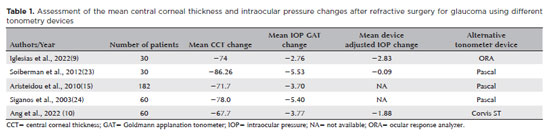
Myopia is a significant risk factor for glaucoma and a growing public health problem worldwide. Detecting glaucomatous changes in highly myopic eyes is diagnostically challenging due to the abnormal appearance of the optic nerve head. These patients also have a greater biomechanical susceptibility to pressure-induced glaucomatous damage. Refractive surgery has become increasingly popular, and many candidates for refractive surgery are myopic. Therefore, we sought to review the aspects of patient evaluation in those who have undergone refractive surgery for myopia concerned with the detection and monitoring of glaucoma development. We identified several important elements of patient evaluation for glaucoma after refractive surgery. These included the need for both structural and functional assessments before and after surgery, and the importance of monitoring for postoperative biomechanical changes in the cornea and their impact on intraocular pressure. We conclude that, in patients who undergo refractive surgery for myopia, it is essential to assess for the presence of glaucoma, to identify staging, and to plan for long-term control of the disease, regardless of IOP.
Keywords: Glaucoma; Intraocular pressure; Myopia; Refractive surgery
ABO is licensed under a Creative Commons Attribution-NonComercial 4.0 Internacional.

About
Issues
Editorial Board
Submission
Official publication of Conselho Brasileiro de Oftalmologia
Rua Casa do Ator, 1.117 - 2º andar - CEP: 04546-004
São Paulo - SP, Brazil
Phone: +55 11 3266-4000