Showing of 1 until 15 from 188 result(s)
Search for: Arthritis, rheumatoid; Keratoconjunctivitis sicca; Scleritis; Corneal ulcer; Uveitis, anterior; Adrenal cortex hormones; HLA-DR4 antigen; HLA-B27 antigen; Humans; Middle aged; Female; Case reports
Abstract
Objetivo: Descrever as manifestações oftalmológicas observadas em pacientes com artrite psoriásica atendidos no Serviço de Reumatologia da Universidade do Estado do Pará.
Métodos: Estudo transversal. A amostra foi composta por 23 pacientes com artrite psoriásica, segundo os critérios de Caspar, atendidos no ambulatório de reumatologia da Universidade do Estado do Pará. Para avaliação da atividade de doença foi aplicado o Clinical Disease Activity index for Psoriatic Arthritis e, posteriormente, foi realizado o exame oftalmológico (acuidade visual com correção para distância, biomicroscopia, tonometria de aplanação de Goldmann, fundoscopia, teste de Schirmer I, tempo de ruptura do filme lacrimal, lissamina verde e questionário The Ocular Surface Disease Index).
Resultados: Nesta pesquisa não houve predomínio entre os sexos e a população tinha uma mediana de idade de 47,78 anos. As manifestações mais comuns foram olho seco (60,9%), catarata (56,5%), blefarite (47,8%), ceratite (43,5%), meibomite (30,4%) e pterígio (26,1%).
Conclusão: As manifestações oculares encontradas em pacientes com artrite psoriásica são variadas e afetam sobretudo a superfície ocular; no entanto, são clinicamente subestimadas; por isso recomenda-se o acompanhamento oftalmológico regular e periódico para pacientes com artrite psoriásica.
Keywords: Artrite psoriásica; Manifestação ocular; Ceratoconjuntivite seca; Síndrome do olho seco; Blefarite
Abstract
OBJETIVO: Avaliar a morfologia da córnea e da câmara anterior em olhos fácicos com inflamação intraocular não infecciosa.
MÉTODOS: Esse estudo incluiu 59 olhos com uveíte ativa, 62 olhos com uveíte inativa e 95 olhos saudáveis. A densidade de células endoteliais da córnea, a proporção de células hexagonais, o coeficiente de variação, o volume e a espessura da córnea, a ceratometria máxima e o volume e profundidade da câmara anterior foram medidos com um microscópio especular e uma Pentacam HR.
RESULTADOS: A duração média da uveíte foi de 24,6 ± 40,5 (0-180) meses. O número médio de crises de uveíte foi de 2,8 ± 3,0 (1-20). O coeficiente de variação foi significativamente maior no grupo com uveíte ativa do que no grupo com uveíte inativa (p=0,017, Tukey post-hoc). Não houve diferença significativa nos demais parâmetros do segmento anterior entre os grupos com uveíte ativa, com uveíte inativa e controle (p>0,05). A análise de regressão linear múltipla demonstrou que o coeficiente de variação foi maior na uveíte ativa do que na uveíte inativa, após ajustes para a duração e tipo de uveíte e a presença ou não de doença reumática e de tratamento imunossupressor (p=0,003). A duração da uveíte e o número de crises não demonstraram correlação significativa com os parâmetros oculares (p>0,05, correlação de Spearman). A diferença nos parâmetros não demonstrou correlação significativa com o tipo de uveíte (p>0,05).
CONCLUSÕES: O coeficiente de variação foi maior nos olhos com uveíte ativa do que naqueles com uveíte inativa, ao passo que a densidade de células endoteliais e a morfologia da câmara anterior não mostraram diferenças significativas entre os grupos com uveíte ativa, com uveíte inativa e controle.
Keywords: Câmara anterior; Inflamação; Epitélio posterior; Contagem de células; Uveites
Abstract
Objetivo: Examinar o efeito de infiltrados sub-epiteliais corneanos nas propriedades biomecânicas da córnea após ceratoconjuntivite epidêmica, em comparação com controles saudáveis.
Métodos: Este estudo transversal incluiu pacientes consecutivos com infiltrados sub-epiteliais corneanos bilaterais após ceratoconjuntivite epidêmica e controles saudáveis. Foram medidas a melhor acuidade visual corrigida, uma pontuação do infiltrado sub-epitelial da córnea, a escala de graduação de Fantes e a espessura central da córnea. A histerese da córnea, o fator de resistência da córnea, a pressão intraocular correlacionada à tonometria de Goldmann e a pressão intraocular compensada da córnea foram avaliados com o Ocular Response Analyzer.
Resultados: Este estudo incluiu 66 olhos de 33 pacientes com infiltrados corneanos sub-epiteliais após ceratoconjuntivite epidêmica e selecionou aleatoriamente 37 olhos de 37 voluntários saudáveis. As pontuações médias da escala de Fantes e dos infiltrados sub-epiteliais corneanos nos primeiros olhos acometidos foram respectivamente de 1,8 ± 0,8 e 2,9 ± 1,3. Nos olhos contralaterais, foram respectivamente de 1,3 ± 1,1 e 1,9 ± 1,7 (p=0,009 e p=0,002, respectivamente). O primeiro e o segundo olhos envolvidos tinham córneas significativamente mais finas (respectivamente 526,1 ± 28,1 µm; p=0,005 e 523,4 ± 38,1 µm; p=0,044) em comparação com os controles saudáveis (557,0 ± 38,1 µm). Embora a acuidade visual melhor corrigida tenha mostrado uma correlação positiva com o fator de resistência da córnea (r=0,363, p=0,045) e com a histerese da córnea (r=0,414, p=0,021), a pontuação dos infiltrados sub-epiteliais corneanos mostrou uma correlação negativa com a pressão intraocular correlacionada à tonometria de Goldmann (r=-0,479, p=0,006) e com a pressão intraocular compensada da córnea (r=-0,413, p=0,021).
Conclusão: Os olhos com infiltrados corneanos sub-epiteliais tinham córneas significativamente mais finas em comparação com os controles saudáveis. Ao se medirem os valores de pressão intraocular em pacientes com infiltrados sub-epiteliais corneanos, deve-se levar em consideração tanto as correlações positivas do fator de resistência da córnea e da histerese da córnea com a melhor acuidade visual corrigida quanto as correlações negativas da pressão intraocular correlacionada à tonometria de Goldmann e da pressão intraocular compensada da córnea com a pontuação do infiltrado sub-epitelial da córnea.
Keywords: Ceratoconjuntivite; Pressão intraocular; Epitélio corneano; Corticosteroides; Ciclosporina;Tonometria ocular

Abstract
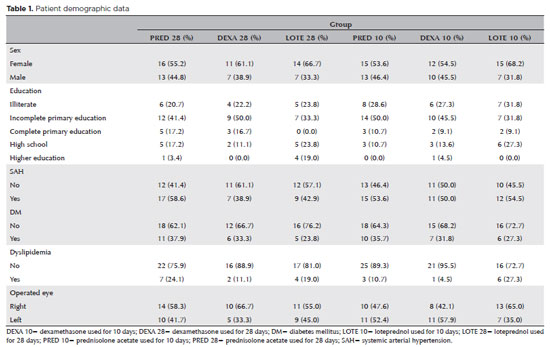
PURPOSE: To evaluate the efficacy of different corticosteroid eye drop formulations (prednisolone acetate 1.0%, dexamethasone 1.0%, and loteprednol etabonate 0.5%) administered for different treatment durations (10 vs. 28 days) in controlling postoperative inflammation following uncomplicated cataract surgery.
METHODS: This randomized, masked clinical trial was conducted at the Instituto Cearense de Oftalmologia. Eligible participants were aged ≥50 yr and scheduled for routine cataract surgery. Exclusion criteria included preexisting ocular disease (elevated intraocular pressure, retinopathy, maculopathy, or uveitis) or concurrent medication use that could confound results. Patients were randomized to receive prednisolone acetate (1.0%), dexamethasone (1.0%), or loteprednol etabonate (0.5%) four times daily for 28 days (with tapering) or for 10 days. Medication bottles, prescriptions, and examiners were masked. Postoperative assessments included ocular symptoms, visual acuity, intraocular pressure, anterior chamber cell count and flare, pachymetry, endothelial cell density, and macular thickness over a 30-day follow-up.
RESULTS: A total of 140 eyes from 140 patients were analyzed (29 prednisolone acetate 1.0%, 18 dexamethasone 1.0%, and 21 loteprednol etabonate 0.5% for 28 days; 28 prednisolone acetate 1.0%, 22 dexamethasone 1.0%, and 22 loteprednol etabonate 0.5% for 10 days). No significant differences were found among the six groups during follow-up. However, eyes treated with dexamethasone (1.0%) showed greater intraocular pressure fluctuations, particularly on Days 7 and 30, and a higher incidence of rebound inflammation in the 28-day regimen. Structural cystoid macular edema without visual impact was observed in 5.9% of eyes in the 28-day groups and 14.2% of eyes in the 10-day groups, as detected by optical coherence tomography at 30 days.
CONCLUSION: Equivalent postoperative inflammation control can be achieved using different corticosteroid eye drop formulations at varying treatment durations following cataract surgery. Brazilian Registry of Clinical Trials (ReBEC): RBR-2frpntv
Keywords: Adrenal cortex hormones; Cataract; Cystoid macular edema; Corticosteroids; Inflammation; Loteprednol etabonate; Ophthalmic solutions; Postoperative period; Intraocular pressure; Visual acuity
Abstract
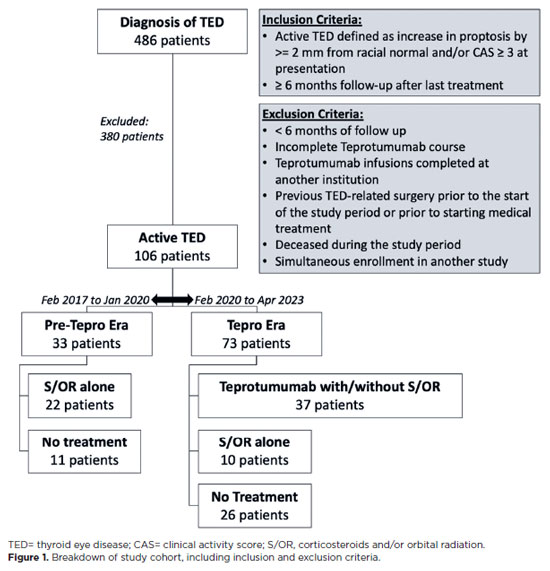
PURPOSE: This study evaluated rates of thyroid eye disease-related eyelid surgeries, strabismus surgeries, and orbital decompressions in active thyroid eye disease patients treated with teprotumumab compared to those who were not.
METHODS: In this single-center longitudinal study, we compared patients with active thyroid eye disease evaluated from 02/01/2017 to 01/31/2020 (pre-teprotumumab era) with those seen from 02/01/2020 to 04/30/2023 (teprotumumab era). Patients from the pre-teprotumumab era who received corticosteroids and/or orbital radiation were compared with those in the teprotumumab era treated with teprotumumab, with or without corticosteroids and/or orbital radiation. The primary outcomes were rates of orbital decompressions, strabismus surgery, and eyelid surgery among patients with at least 6 months of follow-up. Orbital decompressions involving two or more walls were classified as severe.
RESULTS: Of 486 records reviewed, 106 patients had active thyroid eye disease. Among them, 33 were from the pre-teprotumumab era; 22 received corticosteroids and/or orbital radiation, and 11 received no treatment. Seventy three patients were from the teprotumumab era; 37 received teprotumumab (with or without corticosteroids and/or orbital radiation), 10 received corticosteroids and/or orbital radiation alone, and 26 received no treatment. Demographics were comparable between groups. Orbital decompression was performed in 11 of 44 eyes (25.0%) in the pre-teprotumumab era treated with corticosteroids and/or orbital radiation (8 one-wall, 3 ≥two-wall), compared to 3 of 74 eyes (4.1%) in the teprotumumab era treated with teprotumumab with or without corticosteroids and/ or orbital radiation (all one-wall). The overall rate of orbital decompressions and the rate of ≥two-wall decompressions were significantly lower in the teprotumumab era (p=0.02 and p=0.0496, respectively). There was no significant difference in one-wall decompressions between era (p=0.07). Rates of strabismus surgeries (27.3% vs. 13.5%, p=0.19) and eyelid surgeries (22.7% vs. 21.6%, p=0.92) did not significantly differ between the era.
CONCLUSIONS: In patients with active thyroid eye disease, treatment with teprotumumab was associated with a significantly lower rate and severity of orbital decompressions compared to treatment with corticosteroids and/or orbital radiation alone. However, the rates of strabismus and eyelid surgeries remained similar between groups.
Keywords: Teprotumumab; Adrenal cortex hormone; Decompression; Graves ophthalmopathy; Strabismus
Abstract
PURPOSE: To evaluate the clinical results of cryopreserved amniotic membrane transplantation as a treatment option for refractory neurotrophic corneal ulcers.
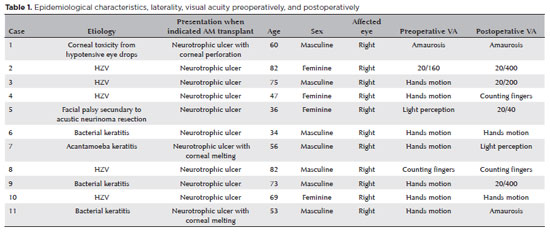
METHODS: This prospective study included 11 eyes of 11 patients who underwent amniotic membrane transplantation for the treatment of refractory neurotrophic corneal ulcers at Hospital de Clínicas da Universidade Federal do Paraná, in the city of Curitiba, from May 2015 to July 2021. Patients underwent different surgical techniques in which the amniotic membrane was applied with the epithelium facing upward to promote corneal re-epithelialization.
RESULTS: The median age of the patients was 60 years (range, 34-82 years), and 64% were men. The predominant etiology of corneal ulcers was herpes zoster (45% of cases). Approximately one-third of the patients (27%) were chronically using hypotensive eye drops, and more than half (54%) had previously undergone penetrating corneal transplantation. At the time of amniotic membrane transplantation, 18% of the eyes had corneal melting, 9% had corneal perforation, and the others had corneal ulceration without other associated complications (73%). The time between clinical diagnosis and surgical treatment ranged from 9 days to 2 years. The corrected visual acuity was worse than 20/400 in 90% of the patients preoperatively, with improvement in 36% after 3 months of the procedure, worsening in 18% and remaining stable in 36%. Of the patients, 81% complained of preoperative pain, and 66% of them reported total symptom relief after the surgical procedure. In one month, 54.6% of the patients presented a closure of epithelial defect, and half of the total group evolved with corneal thinning. The failure rate was 45.5% of the cases.
CONCLUSION: Cryopreserved amniotic membrane transplantation can be considered a good alternative for treating refractory neurotrophic corneal ulcers, as it resulted in significant improvement in pain (66%) and complete epithelial closure (60%) in many patients at 1 month postoperatively. Notably, the high failure rate highlights the need for further studies to identify patient- and ulcer-related factors that may influence the outcomes of this procedure.
Keywords: Amnion/transplantation; Corneal ulcer; Anterior eye segment; Keratitis
Abstract
A ceratite intersticial é uma inflamação do estroma corneano sem envolvimento epitelial ou endotelial causada principalmente por doenças infecciosas e imunomediadas. O Brasil tem altas taxas de tuberculose que deve ser lembrada como causa de ceratite intersticial. Desnutrição e anemia são fatores de risco da forma disseminada da tuberculose. Este é um relato de uma criança de 10 anos com redução de acuidade visual e diagnóstico clínico de ceratite intersticial bilateral e esclerouveíte. O paciente obteve melhora parcial da ceratite com corticoide tópico. Exames laboratoriais mostraram anemia ferropriva grave, sorologias negativas para HIV e sífilis; IgM negativo e IgG positivo para citomegalovírus e herpes simplex e PPD positivo (17 mm). Ele evoluiu com crises tônico-clônicas e a ressonância nuclear magnética revelou tuberculoma do sistema nervoso central. A melhora da ceratite intersticial foi observada após tratamento para tuberculose. Este é o primeiro caso que descreve a associação de ceratite intersticial e tuberculoma do sistema nervoso central.
Keywords: Ceratite; Esclerite; Tuberculoma intracraniano; Tuberculose ocular; Anemia ferropriva; Humanos; Relato de caso.
Abstract
Paciente do sexo masculino, 33 anos, apresentou ceratite infecciosa subaguda unilateral 4 semanas após a cirurgia. A inflamação da córnea foi resistente aos regimes de antibióticos tópicos padrão. A aba da córnea foi derretida e seccionada durante o levantamento e amostragem para diagnóstico. A melhora clínica só foi alcançada após levantamento do retalho, raspagem e diagnóstico microbiológico de micobactérias atípicas e tratamento com amicacina fortificada tópica, claritromicina e claritromicina sistêmica.
Keywords: Córnea/microbiologia; Úlcera da córnea; Infecções oculares bacterianas; Mycobacterium abscessus; Procedimentos cirúrgicos refrativos; Ceratomileuse assistida por excimer laser in situ; Amicacina/uso terapêutico; Claritromicina/uso terapêutico; Humanos; Re
Abstract
A ocorrência de ectasia corneana após ceratectomia fotorrefrativa é uma complicação rara, porém grave, em cirurgia refrativa. Os possíveis fatores de risco não são bem avaliados, mas a opinião atual é que a falha na detecção de ceratocone pré-operatório possa ser o principal motivo. Neste relato, descrevemos um caso de ectasia corneana após ceratectomia fotorrefrativa em paciente apresentando padrão tomográfico suspeito no pré-operatório, mas sem alterações degenerativas associadas a ceratocone patológico, conforme revelado por microscopia confocal in vivo da córnea. Além disso, revisamos, na literatura, relatos de casos elegíveis de ectasia pós-ceratectomia fotorrefrativa para encontrar características semelhantes.
Keywords: Córnea/patologia; Dilatação patológica; Ceratoconus; Ceratectomia fotorrefrativa; Ceratomileuse assistida por excimer laser in situ; Microscopia confocal; Humanos; Relato de casos
Abstract
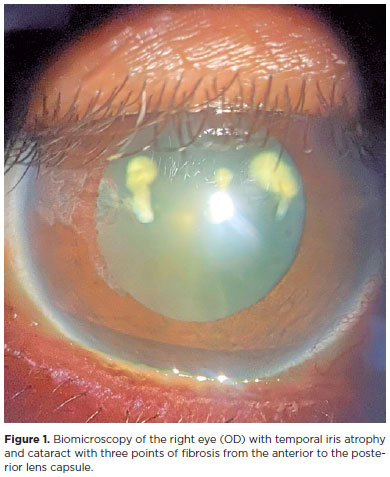
Aging and face sagging have many causes, and various techniques are used for treatment, including noninvasive procedures, such as focused ultrasound, which uses the principle of collagen regeneration by coagulative necrosis of the dermis layers using radiofrequency, but this procedure has complications. We reported a case of a 54-year-old female patient who complained of poor visual acuity in her right eye three days after a focused ultrasound facial aesthetic procedure, with the best visual acuity of 20/60. Biomicroscopy of the right eye revealed an acute cataract with three points of fibrosis extending from the posterior to the anterior capsule. The patient underwent phacoemulsification surgery with visual rehabilitation and improved vision of 20/20. We hypothesized that the occurrence of acute cataract was related to the inappropriate use of focused ultrasound.
Keywords: Cosmetic techniques; Skin aging; Rejuvenation; Ultrasonic therapy/adverse effects; High-intensity focused ultrasound ablation/methods; Cataract/etiology; Phacoemulsification; Lens implantation, intraocular; Visual acuity; Humans; Middle age; Female; Case
Abstract
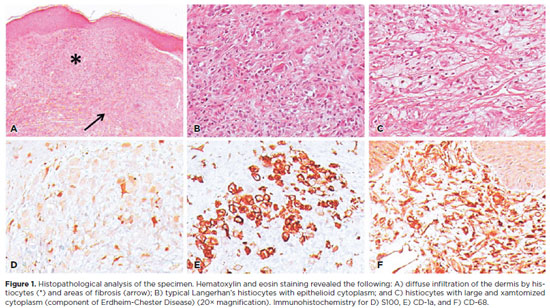
Langerhans cell histiocytosis comprises a heterogeneous range of clinical manifestations secondary to clonal proliferation of histiocytes, characterized by the accumulation of these cells in various organs and tissues. The ophthalmological component commonly involved is the orbit. Herein, we report a rare case of Langerhans cell histiocytosis with eyelid involvement, which resulted in severe ocular surface complications, which subsequently significantly impacted the patient's quality of life. This case report highlights the fact that despite being rare, Langerhans cell histiocytosis should be included in the differential diagnosis of eyelid lesions. Furthermore, a multidisciplinary approach with a systemic overview is crucial for managing the ocular complications.
Keywords: Dry eye syndromes; Erdheim-Chester disease/drug therapy; Human; Female; Case reports
Abstract
Os autores relatam o caso de paciente do sexo masculino, 8 anos de idade, com história de uveíte crônica anterior unilateral há quatro meses, associada a lesão pigmentada envolvida por material fibrinóide em ângulo camerular inferior e a lesão fibrótica em extrema periferia de retina inferior. Não havia histórico de trauma ou outros sintomas clínicos. A hipótese de toxocaríase foi afastada diante de testes sorológicos negativos. Melhoria sintomática parcial foi alcançada com administração de corticosteróide vias oral e tópica. Ademais, redução na quantidade de material fibrinóide ao redor da lesão camerular a revelou regular e cilíndrica. Foi realizada tomografia computadorizada de órbitas, permitindo a detecção de corpo estranho metálico na topografia de ângulo camerular inferior. O paciente foi submetido a remoção do corpo estranho através de incisão corneana e a fotocoagulação ao redor da tração retiniana inferior. Excelentes resultados visual e anatômico foram obtidos.
Keywords: Corpos estranhos no olho; Uveíte anterior; Uveíte intermediária; Edema da córnea; Toxocaríase
Abstract
Paciente de 45 anos, sexo feminino queixava-se de hiperemia e dor no olho direito há sete dias. Encontrava-se sob investigação de alterações urinárias e relatou história pregressa de úlceras orais e hiperemia ocular bilateral recorrentes. A acuidade visual corrigida era de 20/30 no olho direito e 20/20 no esquerdo. A biomicroscopia da superfície ocular do olho direito revelou intensa hiperemia escleral em região nasal que persistiu após a instilação de fenilefrina tópica a 10%, reforçando o diagnóstico clínico de esclerite anterior unilateral. A biópsia renal revelou a presença de imunocomplexos de IgA e confirmou a hipótese de doença de Berger. Uma terapia imunossupressora de manutenção com azatioprina após 6 meses de indução de remissão com ciclofosfamida foi necessária após pulsoterapia com metilprednisolona. A esclerite geralmente está relacionada a doenças autoimunes sistêmicas, como artrite reumatoide e poliangeite. Descrevemos aqui um caso raro de esclerite anterior unilateral associada à doença de Berger.
Keywords: Glomerulonefrite; Imunoglobulina; Esclerite; Azatioprina; Ciclofosfamida; Relatos de casos
Abstract
É apresentado um caso raro de ceratomalácia paracentral aguda estéril e perfuração da córnea em uma paciente de 86 anos, uma semana após cirurgia para catarata sem intercorrências. Também são discutidos possíveis mecanismos de patogênese e a literatura relevante é revisada. Esses distúrbios da superfície ocular ocorreram devido à irradiação da pálpebra inferior e da bochecha em um tratamento de câncer e a uma artrite reumatoide não diagnosticada anteriormente. A paciente submeteu-se a um tratamento cirúrgico com um flap conjuntival de Gundersen sobre a perfuração existente, devido às suas baixas expectativas visuais e à relutância em submeter-se a uma ceratoplastia da córnea, considerando o risco de rejeição do enxerto corneano. Deve-se sempre considerar o risco de ocorrência de ceratomalácia aguda após cirurgias de catarata sem complicações em olhos apresentando distúrbios da superfície ocular.
Keywords: Perfuração da córnea; Radiação; Artrite reumatoide; Extracão de catarata
Abstract
Paciente feminina de 38 anos com queixa de fotopsias e perda visual indolor em seu olho direito 2 semanas após ter recebido a primeira dose de vacina de vírus inativo para COVID-19 (Sinovac/China National Pharmaceutical Group). Ao exame Oftalmológico, apresentava padrão granular macular, múltiplas lesões cinza-esbranquiçadas no polo posterior, associado à reação vítrea inflamatória. O diagnóstico de múltiplos pontos brancos evanescentes foi realizado após análise multimodal. A paciente foi tratada com corticosteroides sistêmico e evoluiu com melhora da acuidade visual e do quadro clínico.
Keywords: Múltiplos pontos brancos/diagnóstico; COVID-19; Infecção por coronavirus; Vacina; Vacinação; Corticosteroides
ABO is licensed under a Creative Commons Attribution-NonComercial 4.0 Internacional.

About
Issues
Editorial Board
Submission
Official publication of Conselho Brasileiro de Oftalmologia
Rua Casa do Ator, 1.117 - 2º andar - CEP: 04546-004
São Paulo - SP, Brazil
Phone: +55 11 3266-4000