Showing of 1 until 14 from 131 result(s)
Search for: Hereditary nephritis; Hereditary nephritis; Hereditary nephritis; Visual acuity; Case report
Abstract
Objetivos: Descrever os achados na angiografia por tomografia de coerência óptica associada à síndrome de Alport.
Métodos: Estudo descritivo de um serviço de referência em Oftalmologia (Hospital Evangélico de Vila Velha, Brasil). Os pacientes diagnosticados com síndrome de Alport, foram incluídos.
Resultados: O grupo de estudo foi composto por quatro pacientes (um feminino e três homens) com diagnóstico de síndrome de Alport. A acuidade visual no pior olho estava entre 20/40 a 20/60. Todos os pacientes do sexo masculino apresentaram lenticone anterior à biomiscroscopia. Os achados da retina observados incluíram pontos e manchas e alterações pigmentares na mácula. Na angiotomografia de coerência óptica, as camadas internas da retina de todos os pacientes apresentaram afinamento (especialmente na região temporal da mácula) e aumento da zona avascular foveal. Uma coroide espessa foi observada em ambos os olhos dos dois pacientes mais jovens.
Conclusões: Em pacientes com síndrome de Alport, as camadas internas da retina sofrem alterações devido à mutação do colágeno tipo IV. A angiotomografia de coerência óptica permite visualizar esses achados, tornando-o uma ferramenta útil na detecção de achados iniciais da retina associados à síndrome de Alport.
Keywords: Retina; Tomografia de coerência óptica; Angiofluoresceínografia/métodos; Nefrite hereditária
Abstract
PURPOSE: This study aimed to characterize retinitis pigmentosa associated with the eyes shut homolog gene, which causes hereditary retinal degeneration.
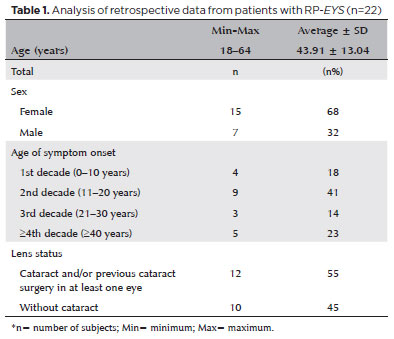
METHODS: The anatomical and functional findings of retinitis pigmentosa in patients with variants of the eyes shut homolog gene were characterized and compared using multimodal imaging and genetic analysis of the variants. Clinical data such as visual acuity, lens status, and refraction were obtained from medical records. Patients underwent an ophthalmic examination, including static visual field, microperimetry, optical coherence tomography, fundus autofluorescence, and fundus photography.
RESULTS: Twenty-two patients were included in the study. Several anatomical and functional characteristics of retinitis pigmentosa-eyes shut homolog were identified, including the presence of cataracts, cystoid macular edema, epiretinal membrane, and a tubular visual field. Genetic results revealed 26 distinct variants in the cohort, with 7 novel variants not previously documented or reported in the scientific literature or databases.
CONCLUSION: The findings demonstrate that eyes shut homolog-retinitis pigmentosa manifests in specific patterns, starting in adolescence with mild progression and advancing with age. The integration of multimodal imaging and genetic analysis has provided a detailed understanding of the anatomical and functional features of retinitis pigmentosa-eyes shut homolog. Seven novel variants of the eyes shut homolog gene have been identified. These findings enhance the understanding of eyes shut homolog-related retinitis pigmentosa characteristics of by detailing the spectrum of mutations in this gene within the Brazilian population.
Keywords: Retinal diseases/diagnostic imaging; Retinitis pigmentosa/genetics; Retinal degeneration; Eye proteins/genetics; Eye diseases, hereditary/genetics; Genes, recessive; Phenotype; Multimodal imaging; Tomography, optical coherence/methods; Fluorescein angiogr
Abstract
PURPOSES: This study aims to assess and compare the postoperative visual and topographic outcomes, complications, and graft survival rates following deep anterior lamellar keratoplasty and penetrating keratoplasty in patients with macular corneal dystrophy.
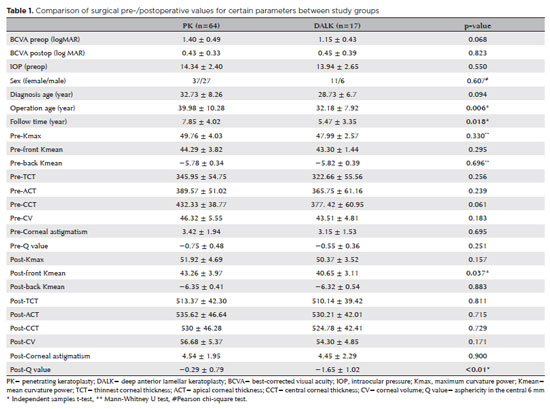
METHODS: In this study we enrolled 59 patients (23 male; and 36 female) with macular corneal dystrophy comprising 81 eyes. Out of these, 64 eyes underwent penetrating keratoplasty, while 17 eyes underwent deep anterior lamellar keratoplasty. The two groups were analyzed and compared based on best-corrected visual acuity, corneal tomography parameters, pachymetry, complication rates, and graft survival rates.
RESULTS: After 12 months, 70.6% of the patients who underwent deep anterior lamellar keratoplasty (DALK) and 75% of those who had penetrating keratoplasty (PK) achieved a best-corrected visual acuity of 20/40 or better (p=0.712). Following surgery, DALK group showed lower front Kmean (p=0.037), and Q values (p<0.01) compared to the PK group. Postoperative interface opacity was observed in seven eyes (41.2%) in the DALK group. Other topography values and other complications (graft rejection, graft failure, cataract, glaucoma, microbial keratitis, optic atrophy) did not show significant differences between the two groups. The need for regrafting was 9.4% and 11.8% in the PK and DALK groups, respectively (p=0.769). Graft survival rates were 87.5% and 88.2% for PK and DALK; respectively (p=0.88 by Log-rank test).
CONCLUSION: Both PK and DALK are equally effective in treating macular corneal dystrophy, showing similar visual, topographic, and survival outcomes. Although interface opacity occurs more frequently after DALK the visual results were comparable in both groups. Therefore, DALK emerges as a viable surgical choice for patients with macular corneal dystrophy without Descemet membrane involvement is absent.
Keywords: Macular corneal dystrophy; Corneal dystrophies; Hereditary; Keratoplasty; Penetrating; Corneal transplantation

Abstract
O coloboma ocular é o resultado de um fechamento impróprio da fissura embrionária. As drusas da cabeça do nervo óptico são depósitos hialinos localizados anteriormente à lâmina cribosa que crescem e se calcificam com o tempo. A associação de ambos é rara, com apenas dois casos descritos na literatura. Apresentamos um paciente com coloboma irido-coriorretiniano e limites do nervo óptico mal definidos em seu olho direito, e aumento da ramificação vascular papilar e atrofia peripapilar em seu olho esquerdo, sem drusas visíveis. Autofluorescência de fundo, tomografia de coerência óptica de alta resolução e ultrassonografia B-scan foram realizadas confirmando o diagnóstico de drusas enterradas bilaterais da cabeça do nervo óptico. A associação entre colobomas irido-coriorretinianos com drusas do nervo óptico na ausência de doença sistêmica é excepcional. Nosso caso demonstra a importância da imagem multimodal para o diagnóstico correto de drusas enterradas de cabeça do nervo óptico.
Keywords: Coloboma; Retina/anormalidade; Doença do nervo óptico; Drusas do disco óptico; Tomografia de coerência óptica; Acuidade visual; Humano; Relato de caso
Abstract
Paciente de 45 anos, sexo feminino queixava-se de hiperemia e dor no olho direito há sete dias. Encontrava-se sob investigação de alterações urinárias e relatou história pregressa de úlceras orais e hiperemia ocular bilateral recorrentes. A acuidade visual corrigida era de 20/30 no olho direito e 20/20 no esquerdo. A biomicroscopia da superfície ocular do olho direito revelou intensa hiperemia escleral em região nasal que persistiu após a instilação de fenilefrina tópica a 10%, reforçando o diagnóstico clínico de esclerite anterior unilateral. A biópsia renal revelou a presença de imunocomplexos de IgA e confirmou a hipótese de doença de Berger. Uma terapia imunossupressora de manutenção com azatioprina após 6 meses de indução de remissão com ciclofosfamida foi necessária após pulsoterapia com metilprednisolona. A esclerite geralmente está relacionada a doenças autoimunes sistêmicas, como artrite reumatoide e poliangeite. Descrevemos aqui um caso raro de esclerite anterior unilateral associada à doença de Berger.
Keywords: Glomerulonefrite; Imunoglobulina; Esclerite; Azatioprina; Ciclofosfamida; Relatos de casos
Abstract
A manifestação oftálmica mais frequentemente relatada da infecção por SARS-CoV-2 é a conjuntivite. Trata-se de estudo de caso de retinopatia tipo Purtscher em uma paciente com coagulopatia grave associada ao COVID-19. Uma jovem com múltiplas comorbidades foi admitida por síndrome do desconforto respiratório agudo relacionado ao COVID-19. Seu quadro foi complicado pela fungemia. O exame oftálmico revelou pólo posterior bilateral, lesões intraretinianas e o fluconazol foi adicionado para tratar a retinite fúngica presumida. No decorrer de uma semana, manchas largas peripapilares de algodão e hemorragias sugestivas de retinopatia tipo Purtscher foram observadas. Os dímeros D, o fibrinogênio e a proteína c-reativa estavam acentuadamente elevados antes da nossa consulta, indicando um estado pró-trombótico e pró-inflamatório precedente. O duplex venoso subsequente revelou trombose venosa profunda nas veias subclávia direita e jugular interna. Os índices de fatores von Willebrand estavam marcadamente elevados, sugerindo coagulopatia grave associada ao COVID-19. A retinopatia tipo Purtscher, uma microangiopatia oclusiva rara foi descrita em várias condições pró-inflamatórias e pró-trombóticas. Para nosso conhecimento, este é o primeiro relatório de retinopatia tipo Purtscher com coagulopatia associada ao COVID-19.
Keywords: Doença retiniana; Infecção por coronavírus; Síndrome respiratória aguda grave; Relato de caso.
Abstract
O leiomiossarcoma da conjuntiva é um tumor maligno de tecidos moles muito raro. Aqui é descrito um caso de leiomiossarcoma da conjuntiva em um paciente com xeroderma pigmentoso, que também é uma doença rara. Um paciente de 27 anos de idade com xeroderma pigmentoso de olho único queixou-se de uma massa exofítica cobrindo a superfície ocular do olho esquerdo. Ao exame, foi observada uma massa vascular hemorrágica cobrindo toda a superfície ocular do olho esquerdo. Foi realizada uma cirurgia de excisão total dessa massa. O diagnóstico patológico foi compatível com leiomiossarcoma da conjuntiva. O paciente recusou qualquer quimioterapia, radioterapia ou cirurgia adicional. Nenhuma recidiva ou metástase foi observada durante o acompanhamento de 5 anos. Tanto o leiomiossarcoma primário da conjuntiva quanto o xeroderma pigmentoso são doenças muito raras. Massas conjuntivais em pacientes com xeroderma pigmentoso devem ser abordadas com cuidado e deve-se realizar um exame histopatológico. Para o leiomiossarcoma conjuntival, o diagnóstico precoce, uma doença localizada e não disseminada e a ressecção completa proporcionam o melhor prognóstico.
Keywords: Neoplasias da túnica conjuntiva; Leiomiossarcoma; Xeroderma pigmentoso; Humanos; Relato de caso.
Abstract
Uma paciente de 38 anos desenvolveu afacia e aniridia secundárias a um trauma, levando à perda da visão. Para melhorar sua visão, um complexo de íris e lente intraocular (Reper®) foi fixado à esclera com a técnica de flange duplo de Canabrava. Houve um aumento satisfatório na acuidade visual do paciente e nenhuma complicação foi observada durante o acompanhamento de 6 meses. A técnica de Canabrava simplifica e melhora a fixação do complexo de íris e lente intraocular na esclera. É uma opção segura que não requer retalhos ou pontos esclerais.
Keywords: Afacia/etiologia; Aniridia; Implante de lente intraocular; Lentes intraoculares; Esclera/cirurgia; Acuidade visual; Humanos; Relatos de casos.
Abstract
Este artigo relata o caso de um paciente do sexo masculino, 11 anos de idade, com história de proptose e baixa de acuidade visual progressiva. Ao exame oftalmológico apresentava melhor acuidade visual de 20/25 em olho direito e percepção de luz em olho esquerdo. Existia exotropia e limitação à adução no olho esquerdo. À campimetria automatizada, observou-se quadrantopsia temporal inferior em olho direito e escotoma total em olho esquerdo. À ressonância magnética, evidenciou-se lesão expansiva em trajeto do nervo óptico esquerdo estendendo-se até região do tronco encefálico, com acometimento quiasmático. O objetivo deste artigo é relatar o glioma de vias ópticas, bem como discutir os achados e sua interligação com a literatura atual.
Keywords: Glioma; Neoplasias do nervo óptico; Quiasma óptico; Astrocitoma; Imageamento por ressonância magnética; Acuidade Visual; Relatos de casos; Humanos.
Abstract
We present a case of a patient complaining of monocular diplopia due to a decentered ablation after LASIK. The patient underwent a wavefront-guided retreatment, which resulted in an epithelial ingrowth complication. Additionally, the patient developed cataract, with cataract surgery requiring reliable biometric measurements. Therefore, we opted for corneal treatment and corneal surface regularization. Although we attempted to lift the flap and wash the interface initially, the procedure proved unsuccessful, thereby necessitating immediate flap amputation. Once the corneal surface was regularized in the seventh postoperative month, transepithelial photorefractive keratectomy was successfully performed to homogenize the ocular surface, thereby significantly improving the patient's corrected visual acuity and resolving monocular diplopia. The surface and corneal curvature stabilized by the fifth month after the procedure. Phacoemulsification was then performed along with the implantation of a toric monofocal lens, which was selected using an appropriate formula, resulting in an excellent uncorrected visual acuity.
Keywords: Refractive surgical procedures; Surgical flap/surgery; Keratomileusis laser In situ/methods; Biometry; Corneal topography; Lasers, Excimer/adverse effects; Dipoplia/etiologia; Visual acuity; Humans; Case reports
Abstract
Uma mulher de 71 anos de idade apresentou neuropatia óptica isquêmica anterior não arterítica no nervo óptico com fibras nervosas peripapilares mielinizadas previamente registradas. Seu histórico médico foi significativo para hipertensão arterial sistêmica controlada, hiperlipidemia e diabetes mellitus. Em ambos os discos ópticos, a tacícula fisiológica esteve ausente. A neuropatia óptica isquêmica anterior não arterítica afetou principalmente os setores temporal e inferior da camada de fibras nervosas da retina peripapilar, como demonstrado pela tomografia de coerência óptica da camada de fibras nervosas da retina e pela angiotomografia de coerência óptica do disco óptico. Ao contrário de outros relatórios publicados, apenas uma ligeira regressão das fibras nervosas mielinizadas foi observada após um ano de acompanhamento. Isto pode ser explicado pelo fato da isquemia ter afetado principalmente os setores temporal e inferior peripapilares, enquanto as fibras nervosas de mielina eram nasal superior ao disco óptico.
Keywords: Neuropatia óptica isquêmica; Fibras nervosas mielinizadas; Doenças do nervo óptico; Tomografia de coerência óptica; Neovascularização retiniana; Acuidade visual; Humanos; Relato de casos
Abstract
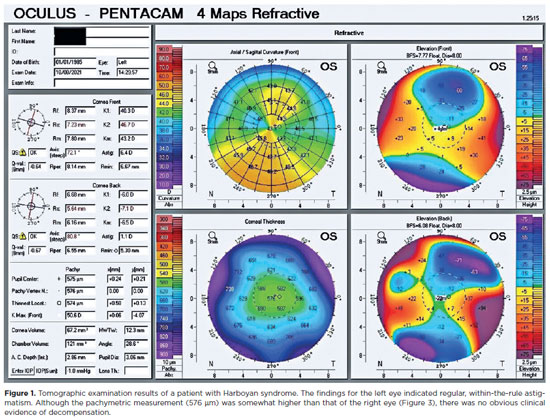
We present the case of a 37-year-old woman who underwent bilateral penetrating keratoplasty for congenital hereditary endothelial dystrophy at the age of 10 years. Over the subsequent 27 years, the patient's vision slowly deteriorated. Our examination revealed decompensation of the right corneal graft. We addressed this with regraft surgery. We then learned that the patient had been suffering from progressive hearing loss since adolescence. Tonal audiometry revealed hearing perceptive deafness of 25 dB, which was more prominent in the left ear. Because the patterns of progressive sensorineural hearing loss and congenital hereditary endothelial dystrophy have both been linked to the same gene, slc4a11, we tested our patient for mutations in this gene. The test was positive for a heterozygous slc4a11 gene fifth exon mutation on chromosome 20p13-p12, which causes a frameshift. A combined clinical and genetic evaluation confirmed a diagnosis of Harboyan syndrome. After the genetic diagnosis of the disease, she was evaluated for the need for a hearing aid due to her hearing loss. The patient was also informed about genetic counseling.
Keywords: Chromosomes; Corneal dystrophies; Exon; Genetic testing; Hearing loss; Hereditary/genetics; Mutation; Sensorineural; slc4a11 gene
Abstract
Aging and face sagging have many causes, and various techniques are used for treatment, including noninvasive procedures, such as focused ultrasound, which uses the principle of collagen regeneration by coagulative necrosis of the dermis layers using radiofrequency, but this procedure has complications. We reported a case of a 54-year-old female patient who complained of poor visual acuity in her right eye three days after a focused ultrasound facial aesthetic procedure, with the best visual acuity of 20/60. Biomicroscopy of the right eye revealed an acute cataract with three points of fibrosis extending from the posterior to the anterior capsule. The patient underwent phacoemulsification surgery with visual rehabilitation and improved vision of 20/20. We hypothesized that the occurrence of acute cataract was related to the inappropriate use of focused ultrasound.
Keywords: Cosmetic techniques; Skin aging; Rejuvenation; Ultrasonic therapy/adverse effects; High-intensity focused ultrasound ablation/methods; Cataract/etiology; Phacoemulsification; Lens implantation, intraocular; Visual acuity; Humans; Middle age; Female; Case
Abstract
PURPOSE: This review emphasizes the effect of light on visual efficiency, the impact of different lighting focuses, types of lighting, and their influence on vision and productivity. Light sources and standards are intriguing subjects for ophthalmologists. Guidelines regarding the level of lighting influence on visual activities can enhance visual performance.
METHODS: This article was developed based on literature reviews, with a bibliographic survey conducted in databases such as PubMed, MEDLINE, Web of Science, Embase, LILACS, and SciELO.
RESULTS: Provides recommendations for understanding information regarding the influence of lighting on visual performance.
CONCLUSION: Proper workplace lighting is crucial for improving visual efficiency, safety, productivity, and worker health. Efficient workplace lighting should avoid light sources directed towards the worker's face, prevent harmful glare, be more intense in the work area, and uniform in the rest of the room. Ophthalmologists should be knowledgeable about and provide guidance on correct lighting to ensure patient comfort and satisfaction with visual correction.
Keywords: Visual performance; Lighting; Visual acuity
ABO is licensed under a Creative Commons Attribution-NonComercial 4.0 Internacional.

About
Issues
Editorial Board
Submission
Official publication of Conselho Brasileiro de Oftalmologia
Rua Casa do Ator, 1.117 - 2º andar - CEP: 04546-004
São Paulo - SP, Brazil
Phone: +55 11 3266-4000