Showing of 1 until 2 from 2 result(s)
Search for: Viviane Alves de Sousa
Abstract
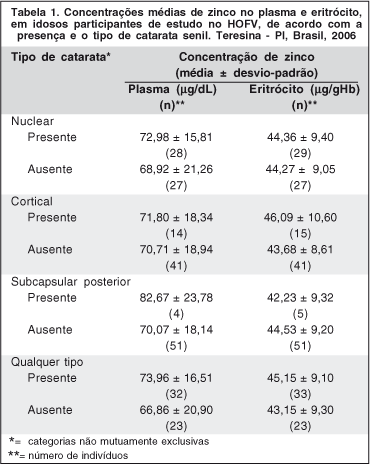
OBJETIVO: Determinar as concentrações plasmáticas e eritrocitárias de zinco em idosos portadores e não-portadores de catarata senil em um serviço oftalmológico especializado, em Teresina-Piauí. MÉTODOS: Estudo quantitativo, transversal e controlado, realizado no Hospital de Olhos Francisco Vilar, Piauí, Brasil. Participaram 56 idosos (37 mulheres, 19 homens) sem condições associadas a modificações nos níveis de zinco ou aumento do risco de catarata. Escore > II foi utilizado para definir a presença de catarata, de acordo com o Lens Opacities Classification System II. As concentrações de zinco foram determinadas por espectrometria de absorção atômica em chama. Análise estatística incluiu os testes t de Student e qui-quadrado e 0,05 como nível de significância. RESULTADOS: Catarata senil foi identificada em 58,9% dos participantes, predominando o tipo nuclear (51,8%), seguido pelo cortical (26,8%) e subcapsular posterior (8,9%). Deficiência de zinco no plasma (<70 μg/dL) e no eritrócito (<40 μg/gHb) foi constatada em 49,1% e 30,4% dos idosos, respectivamente. Não houve diferenças significativas entre portadores e não-portadores de catarata, independente do tipo, quanto às concentrações de zinco plasmático (p=0,165) ou eritrocitário (p=0,426). CONCLUSÃO: Deficiência de zinco no plasma ou eritrócito foi comum entre os idosos; porém, os dados indicam não haver diferenças significativas nos referidos parâmetros quanto à presença de catarata senil, independente do tipo.
Keywords: Zinco; Deficiência de zinco; Catarata; Estado nutricional; Idoso

Abstract
PURPOSE: Endophthalmitis is one of the most important adverse events after cataract surgery, as it can lead to total vision loss. This study aimed to describe the occurrence of endophthalmitis after phacoemulsification with intraocular lens implantation in patients treated in a community setting in Porto Velho, Rondônia, Brazil.
METHODS: This retrospective cohort study was conducted using a database of 649 medical records of patients who underwent surgery and were followed for three months. Poisson regression analysis was used to estimate relative risks and 95% confidence intervals (95% CIs).
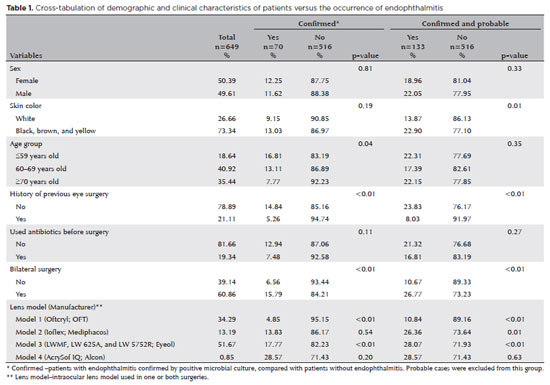
RESULTS: The incidence of confirmed endophthalmitis was 11.94% (95% CI, 9.50-14.76), while the incidence of confirmed and probable cases was 20.50% (95% CI, 17.52-23.73). For confirmed cases, bilateral surgery and the use of lens model 3 were identified as risk factors for endophthalmitis, whereas age over 70 yr and preoperative antibiotic use were protective factors. For confirmed and probable cases, brown and yellow skin color, bilateral surgery, and the use of lens model 3 were also identified as risk factors. Gram-negative bacteria were the predominant etiological agents, and corneal edema was the main clinical manifestation. The mean duration of treatment was eight days, and 27.12% of patients used antibiotics.
CONCLUSION: The incidence observed was substantially higher than that reported in the literature, with a predominance of Gram-negative agents and an association with bilateral surgeries and the Eyeol intraocular lens model. These findings reinforce the need for continuous epidemiological surveillance and the implementation of specific biosafety and infection control protocols during cataract surgery campaigns.
Keywords: Endophthalmitis; Disease outbreaks; Phacoemulsification; Lens implantation, intraocular; Lenses, intraocular; Cataract; Risk factors; Anti-bacterial agents
ABO is licensed under a Creative Commons Attribution-NonComercial 4.0 Internacional.

About
Issues
Editorial Board
Submission
Official publication of Conselho Brasileiro de Oftalmologia
Rua Casa do Ator, 1.117 - 2º andar - CEP: 04546-004
São Paulo - SP, Brazil
Phone: +55 11 3266-4000