
Arq. Bras. Oftalmol. 2026; 89 (6): 10.5935/0004-2749.2026-0169
Total: 16
Rodrigo Romo-Málaga1; Francisco Javier Valentín-Bravo1; Ángela Martínez-Sobrino1; María Luna-del-Castillo1
DOI: 10.5935/0004-2749.2026-0169
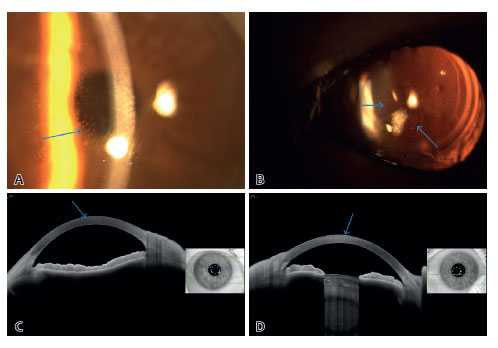
A 78-year-old woman with relapsed IgG-kappa multiple myeloma developed bilateral blurred vision and monocular diplopia 21 days after starting the BelaPd regimen. Slit-lamp examination revealed bilateral subepithelial corneal deposits on direct illumination (Figure 1A, left eye) and retroillumination (Figure 1B, right eye), graded 2–3 according to the KVA scale(1). Anterior segment optical coherence tomography showed microcyst-like epithelial changes, predominantly in the peripheral and paracentral cornea (Figure 1C, right eye, and Figure 1D, left eye)(2,3). The Bowman layer was preserved. The keratopathy resolved 2 months after belamaf was withheld.
REFERENCES
1. Lonial S, Lee HC, Badros A, Trudel S, Nooka AK, Chari A, et al. Belantamab mafodotin for relapsed or refractory multiple myeloma (DREAMM-2): a two-arm, randomised, open-label, phase 2 study. Lancet Oncol. 2020;21(2):207–21.
2. Mencucci R, Cennamo M, Alonzo L, Senni C, Vagge A, Ferro Desideri L, et al. Corneal findings associated to belantamab-mafodotin (belamaf) use in a series of patients examined longitudinally by means of advanced corneal imaging. J Clin Med. 2022;11(10):2884.
3. Matsumiya W, Karaca I, Ghoraba H, Akhavanrezayat A, Mobasserian A, Hassan M, et al. Structural changes of corneal epithelium in belantamab-associated superficial keratopathy using anterior segment optical coherence tomography. Am J Ophthalmol Case Rep. 2021;23:101133.
Submitted for publication:
June 8, 2026.
Accepted for publication:
July 18, 2026.
Data Availability Statement: The datasets generated and/or analyzed during the current study are included in the manuscript.
Edited by
Editor-in-Chief: Newton Kara-Júnior
Associate Editor: Carlos Augusto Moreira Neto
Funding: This study received no specific financial support.
Disclosure of potential conflicts of interest: The authors declare no potential conflicts of interest.

How to cite this article:
 ABO is licensed under a Creative Commons Attribution-NonComercial 4.0 Internacional.